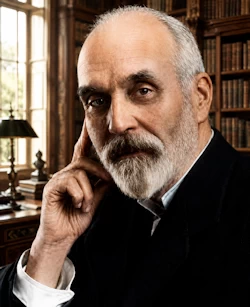
Henry Ernest Dudeney was one of those rare people who could make mathematics feel like a story, a joke, a challenge and a mystery all at once. Born in Sussex in 1857, he did not follow the usual academic path to mathematical fame. Instead, he worked in ordinary jobs, wrote for newspapers and magazines, and developed an extraordinary talent for turning everyday situations into puzzles that made people stop, think and smile.
His puzzles appeared at a time when magazines were a major form of popular entertainment, and Dudeney became one of the great masters of recreational mathematics. Readers encountered his problems in columns such as “Perplexities” in The Strand Magazine, and later in collections including The Canterbury Puzzles and Amusements in Mathematics. His best puzzles were not merely sums dressed up in words; they were little worlds, full of travellers, shopkeepers, chessboards, coins, ropes, animals, bridges and curious arrangements that invited the reader to reason their way to a hidden truth.
than a century later, Dudeney’s work still feels fresh because he understood something every good teacher knows: people enjoy thinking when the question is intriguing enough. His legacy is not just a list of clever answers, but a way of presenting mathematics as play, exploration and surprise. Many of today’s puzzle creators, teachers and maths enthusiasts are still following paths that he helped to mark out.