
|
|
Exam-Style Questions.Problems adapted from questions set for previous Mathematics exams. |
1. | GCSE Higher [427] |
If A is 150% more than B, what is the ratio A:B?
(a) \(1 : 150\)
(b) \(1 : 1.5\)
(c) \(2 : 3\)
(d) \(2 : 5\)
(e) \(5 : 2\)
2. | GCSE Higher [161] |
The Billing triplets are planting seedlings on the first day of the month. The three of them take two hours to plant 300 seedlings.

(a) On the second day of the month the triplets are joined by their friend Billy who helps them. Working at the same rate, how many plants should the four of them be able to plant in two hours?
(b) Working at the same rate, how much longer would it take four people to plant 1000 seedlings than it would take five people?
(c) Billy says that it took two hours for three people to plant 300 seedlings. If I assume they work all day, then in one day three people will plant 3600 seedlings because 300 × 12 = 3600.
Why is Billy's assumption not reasonable? What effect has Billy's assumption had on his answer?
3. | GCSE Higher [641] |
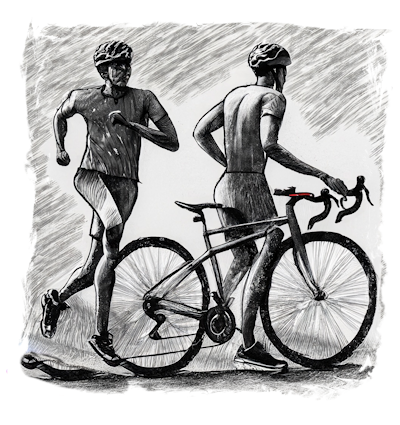
Bruce cycles a distance of 30 km at an average speed of 20 km/h.
He then runs a distance of 8 km at an average speed of 6 km/h.
Work out the total time Bruce takes.
Give your answer in hours and minutes
4. | GCSE Higher [256] |
A Primary school asked 9 children to remove the weeds from the school gardens. The gardens measured 100m2 in total and the job was completed in 10 hours (spread over many weeks).
(a) The school was asked to find volunteers to weed another garden measuring 250m2 at a nursing home. This work has to be completed in 15 hours.
Calculate the least number of children the school needs to find for this work.
(b) State one assumption you have made in your answer to part (a). How would your answer to part (a) change if you did not make this assumption?

5. | GCSE Higher [785] |
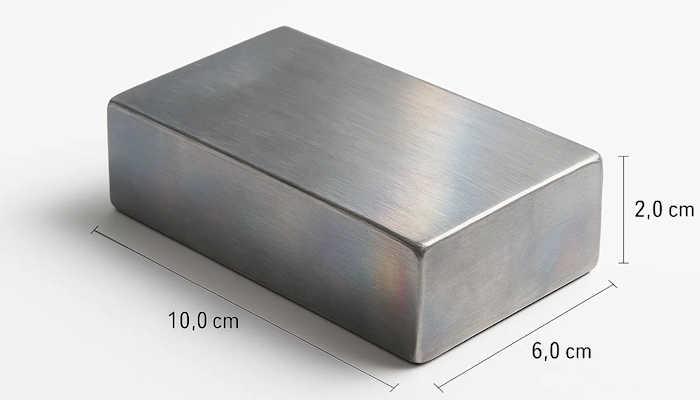
A cuboid made of solid metal measures 10.0 cm by 6.0 cm by 2.0 cm. The block’s mass is 600 g.
Work out:
(a) the volume of the cuboid
(b) the density of the metal in g/cm³
(c) the density of the metal in kg/m³
6. | GCSE Higher [536] |
People are paid to paint polygons.
There are eight people in the polygon painting posse.
All of the people paint at the same rate.
When all of the people are painting, they can paint all of the polygons in the palace in ten days.
The table shows the number of people painting each day:
| Day 1 | Day 2 | Day 4 | All other days | |
| Number of people painting | 3 | 6 | 7 | 8 |
Work out the total number of days taken to paint all of the polygons in the palace.
7. | GCSE Higher [798] |
$$y \propto \frac{1}{ x^2 }$$
When \(y = 9\), \(x = 3\).
(a) Find \(y\) when \(x = 1\).
(b) Find \(x\) when \(y = 2.25\).
8. | GCSE Higher [314] |
Strat drove from Wolverhampton to London via Coventry.
(a) Work out Strat's average speed for his total drive from Wolverhampton to London.
Raven drove from Bedrock to Springfield via South Park.
Raven says that the average speed from Bedrock to Springfield can be found by working out the mean of 70 km/h and 50 km/h.
(b) If Raven is correct, what does this tell you about the two parts of Raven's journey?
9. | GCSE Higher [473] |
Mr Finknottle takes his parents for a drive in his car.
He drives the first ten miles in ten minutes then drives at an average speed of 68 miles per hour for 1 hour 45 minutes.
He finds this information about his car:
| Average Speed (s) | \(s \le 65 mph\) | \( s\gt 65 mph\) |
|---|---|---|
| Miles travelled per gallon | 60 | 50 |
Use the information to find how many gallons of petrol he uses during the drive.
10. | GCSE Higher [540] |
The density of water (at 20°C) is 1.09 g/cm3.
The density of blood is 1.60 g/cm3.
Three litres of water are mixed with four litres of blood for a scientific experiment. Work out the density of the mixture giving your answer correct to 2 decimal places.
11. | GCSE Higher [406] |
The distance from Wolverhampton to Cambridge is 115 miles.
Lynn drives from Wolverhampton to Cambridge leaving Wolverhampton at 10:30am. She assumes that her average speed will be 55 mph.
(a) Use Lynn's assumption about her average speed to work out her arrival time in Cambridge.
(b) Lynn's speed was actually lower than her assumption. How does this affect the arrival time?
12. | GCSE Higher [414] |
The following kinematics formula can be used to work out the distance travelled (displacement) of an object travelling with constant acceleration.
$$ s = ut + \frac12 at^2 $$where:
(a) Rearrange the formula to make \(u\) the subject.
(b) What units would be associated with speed in this case?
(c) What units would be associated with acceleration?
13. | GCSE Higher [465] |
Which of the following statements are correct if \(xy = c\) and \(c\) is a constant.
14. | GCSE Higher [125] |
Henrietta sells the eggs that the chickens on her farm lay.
She has 220 chickens and each chicken lays 5 eggs each week.
Henrietta gives each chicken 80 grams of chicken feed each day which costs £5.50 for a 20 kg bag.
Work out the cost of the chicken feed for every box of six eggs she sells.

15. | GCSE Higher [504] |
If \(a\) is inversely proportional to \(b\) and \(b\) is directly proportional to \(c^2\) find a formula for \(a\) in terms of \(c\) given that \( a=20 \) and \(c = 4 \) when \(b = 8 \).
If you would like space on the right of the question to write out the solution try this Thinning Feature. It will collapse the text into the left half of your screen but large diagrams will remain unchanged.
The exam-style questions appearing on this site are based on those set in previous examinations (or sample assessment papers for future examinations) by the major examination boards. The wording, diagrams and figures used in these questions have been changed from the originals so that students can have fresh, relevant problem solving practice even if they have previously worked through the related exam paper.
The solutions to the questions on this website are only available to those who have a Transum Subscription.
Exam-Style Questions Main Page
To search the entire Transum website use the search box in the grey area below.
Do you have any comments about these exam-style questions? It is always useful to receive feedback and helps make this free resource even more useful for those learning Mathematics anywhere in the world. Click here to enter your comments.