
Sign In | Starter Of The Day | Tablesmaster | Fun Maths | Maths Map | Topics | More
|
New ActivityThe latest activity to be updated on this site is called "Venn Paint" (Flood fill the regions of the Venn diagrams according to the given statements.). So far this activity has been accessed 39159 times and 21318 people have earned a Transum Trophy for completing it. 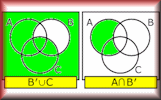
Featured ActivityShunting Puzzles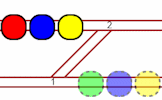 These puzzles are Transum's versions of the shunting or switching puzzles made popular by train enthusiasts and logic puzzle solvers. Recent News:Cambridge scientists create a $10 chip that could put a medical lab on your wristCambridge researchers have created a groundbreaking $10 optical sensor that delivers the precision of laboratory equipment in a device small enough for wearable technology. It identified foods, plastics, and medicines with 100% accuracy in tests and demonstrated the ability to monitor blood glucose, alcohol, and other health markers without invasive procedures. more... Physicists discover “astonishing” property of light that defies expectationsScientists have uncovered a surprising hidden ability of light that allows it to develop spinning, twisting behavior as it travels through empty space, without special lenses, mirrors, or materials. Researchers discovered that light’s internal geometry can naturally produce left- and right-handed patterns, challenging long-standing assumptions about how light behaves. By carefully arranging a beam’s structure, scientists can control where and how these spinning patterns emerge, unlocking a new way to manipulate light. more... Scientists recreate a bizarre quantum effect that stops a particle coldOxford physicists have recreated a bizarre quantum effect in which a particle responds to a magnetic field without ever traveling through it. Using a hybrid quantum computer, they demonstrated how introducing a simulated magnetic flux could completely halt a particle's movement through quantum interference. The experiment brings a decades-old prediction into a new setting where matter and quantum fields influence one another. more... The hidden math of Alzheimer's could point to new treatmentsMathematics may hold unexpected clues to understanding Alzheimer’s disease. Scientists have developed a model showing how common metals like copper and zinc may influence the buildup of proteins associated with the disease, while also exploring possible ways to stop the process. The findings could help researchers identify promising strategies for preventing harmful plaque formation. more... This new qubit could be 100 times less error-prone in superfluid quantum computer breakthroughA proposed qubit made with superfluid helium could cut quantum computing error rates by around 100 times by shielding quantum information from common forms of electromagnetic noise. If experiments confirm the predictions, the technology could eventually work alongside today’s superconducting qubits or serve as a new kind of quantum memory. more... Caltech physicists finally measure a quantum energy ladder predicted 40 years agoResearchers have experimentally observed energy patterns that physicists have predicted for about 40 years. By arranging laser-trapped atoms into a quantum simulator, they recreated two different quantum tipping points and watched the atoms fall into the exact energy ratios predicted by theory. The technique could now be used to explore mysterious quantum systems where scientists do not already know the answer. more... Scientists find that “perfect” systems may be surprisingly fragileComplex systems may work better when their parts are not perfectly alike. Northwestern physicists found that carefully balanced variation, or “disorder,” can make networks such as power grids, ecosystems, neurons, and materials more stable. Even random differences sometimes improved stability compared with completely uniform systems. The discovery could help researchers design more resilient technologies and explain why natural systems are so rarely perfectly uniform. more... |
Latest Newsletters:Have you read the latest Transum Newsletter or listened to the podcast? October 2026
🎃 Boxes of Tricks and Treats October's Newsletter :: Podcasts
September 2026
🐢 Pie Chart Creator September's Newsletter :: Podcasts August 2026
🍦 Master of the House August's Newsletter :: Podcasts July 2026
🎂 Birthday Maths June 2026
🧩 Solvitude Festival May 2026
🛡️ Knights of the Circular Table April 2026
✏️ Quazmere Quadrant puzzle April's Newsletter :: Podcasts March 2026
🦀 A Penguin and a Crab March's Newsletter :: Podcasts February 2026
🟰 Badges for the Cods February's Newsletter :: Podcasts January 2026
⌛ New Year and Time January's Newsletter :: Podcasts December 2025
🎄 ChristMaths Resources December's Newsletter :: Podcasts November 2025
💥 Rock, Paper, Scissors November's Newsletter :: Podcasts |
Do you have any comments? It is always useful to receive feedback and helps make this free resource even more useful for those learning Mathematics anywhere in the world. Click here to enter your comments.
|
Never miss a Transum Tweet again by following Transum on Twitter. |
Transum also has a Facebook page just in case you wanted something else to follow: |
Sign Up for a Transum subscription