
Sign In | Starter Of The Day | Tablesmaster | Fun Maths | Maths Map | Topics | More
This is the Transum Newsletter for the month of August 2026. It begins, as usual, with the puzzle of the month.
Monsieur Thénardier has been doling out the charm, ready with a handshake and an open palm. Meanwhile Madame Thénardier has been cookin’ the books and contemplating interesting facts about the numbers in her life. She has realised that the digits of her age are the digits of her husband’s age reversed. Although he is the older of the two, the difference between their ages is only one-eleventh of their sum. How old are the Thénardiers?

A respectful nod to Les Misérables.
If you get an answer, I'd love to hear how you or your students solved the puzzle. Fire off an email to gro.musnarT@rettelsweN
If one puzzle per month isn't enough for you, have a look at the new Advanced Starter called Pair of Pictures.
While you think about that, here are some of the key resources added to the Transum website over the last month.
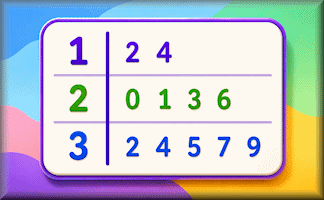
I am very pleased to announce a new activity called Stem and Leaf Diagrams. It includes the classic textbook-style practice of reading, interpreting and constructing stem-and-leaf diagrams, but I have tried to make it more varied than that. Pupils are also asked to compare two distributions, interpret a Japanese railway timetable presented in stem-and-leaf form, and solve a stem-and-leaf diagram puzzle or two. It should provide useful practice for this compact and efficient way of displaying data while also encouraging pupils to think carefully about what the diagram actually tells them.
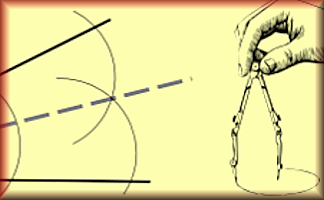
The updated Constructions activity gives students practice with classic ruler-and-compasses skills, including perpendicular bisectors, perpendicular lines, angle bisectors and the construction of special angles. What makes it quite different from a textbook exercise is that each task leads to a measurable result: students complete the construction on paper, measure a length or angle, and enter their answer online for immediate marking. This combines the accuracy and care of traditional geometric construction with the motivation and feedback of a self-marking activity.
Mandy's Matching is a new activity added to the website, contributed by a subscriber. The Percentage Matching activity helps students who struggle to identify which type of percentage problem they're facing: finding a new amount, working backwards to an original value, or calculating a percentage itself. By dragging cards to match word problems with the correct method, students build the skill of recognising problem types before diving into the calculation, a step that often trips learners up more than the maths itself.

I have updated the Cheating poster found on the Back To School page to include a mention of AI.
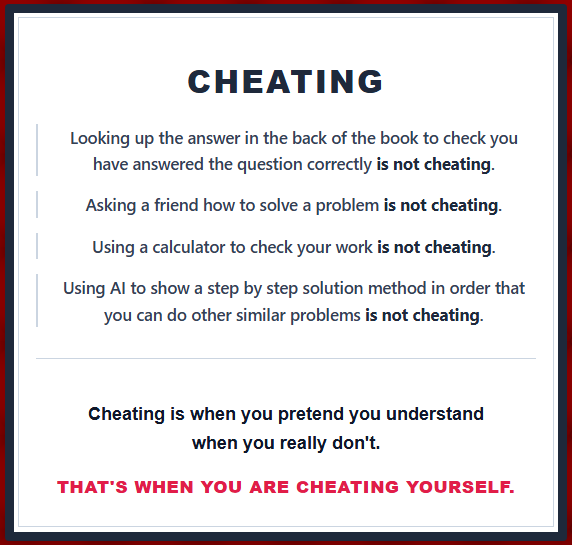
...and on the subject of AI, I asked it to suggest ways students could use it positively and it hardly hesitated before coming up with these bullet points (I hope that's not cheating!):
But for a deeper dive into AI in schools, listen to the current series of the Mr Barton Podcast.
If your students are currently enjoying their long summer break, with apologies once again to those in the Southern Hemisphere, you might like to point them towards the Holiday Maths Activities collection. These are light, recreational challenges designed to keep mathematical minds active without feeling too much like schoolwork. A quick email containing the link may be all the encouragement they need: Holiday Maths Activities.
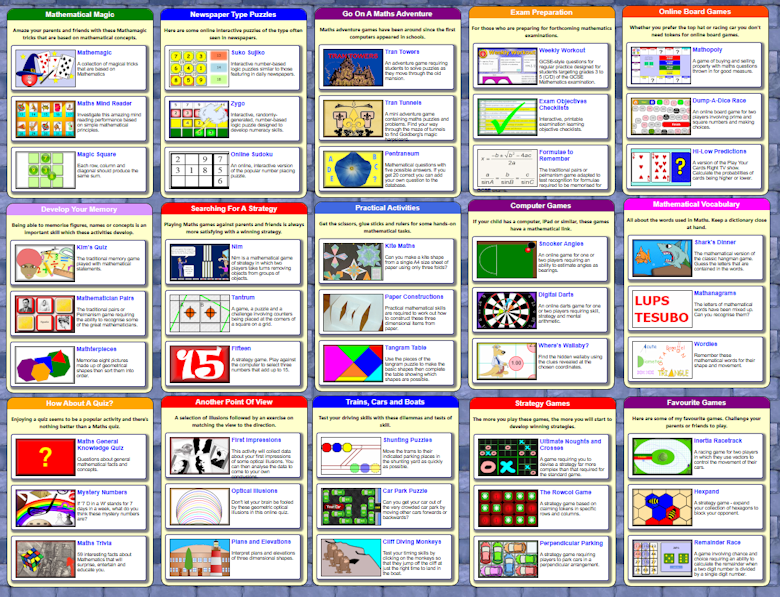
One thing I’ve noticed recently is that many teachers still value resources that are quick and easy to use. While more and more platforms are adding accounts, dashboards, AI features and large curriculum packages, there is still a real need for activities that can be opened instantly and used straight away. Sometimes all you want is a worthwhile ten-minute task to get a lesson off to a flying start, fill a short gap, or reinforce a key idea. That’s exactly the sort of niche Transum has always aimed to fill. Whether you project a Starter for the whole class, set a self-marking activity for independent practice, or use a single question to spark a discussion about different methods, simple resources can often have the biggest impact.
As teachers begin reviewing the 2026 examination series and planning for the new school year, the emerging message is that efficient practice remains essential, but a correct answer and a green tick are not the whole of mathematical learning. Pupils also need opportunities to choose methods, discuss structure, make assumptions and apply familiar ideas in unfamiliar situations. This is where Transum's exam-style questions, investigations, starters and puzzles are so useful. My message has always been to employ a variety of activities and resources, with Transum forming just one part of the big-picture curriculum.

A newly published research preprint reports that pupils receiving frequent, automatically marked handwritten assessments in A-level mathematics and science achieved final mock-examination marks averaging 16.8% higher than a comparison group using conventional teacher marking. Turnaround reportedly fell from an average of 11.2 days to almost immediate feedback, allowing pupils to complete about four times as much assessed practice.
And now for something completely different ... I took the photos below inside an old hardware shophouse converted into a restaurant and bar. I took the photos below last week as I was travelling through a small Thai town. There were literally hundreds of these storage boxes all around the walls that had been left in place after the conversion and each box had a fraction multiplication painted on. I would guess the numbers were the sizes of the items inside. Is this a Year 7 child’s worst nightmare or a trendy decoration for a modern eatery?
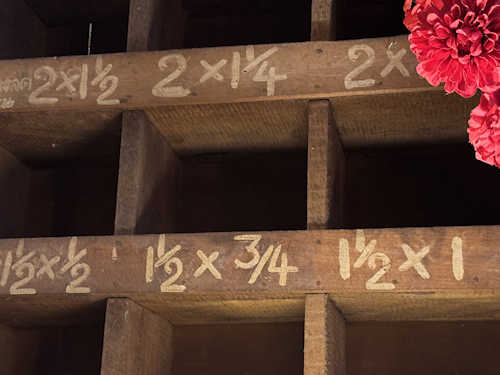
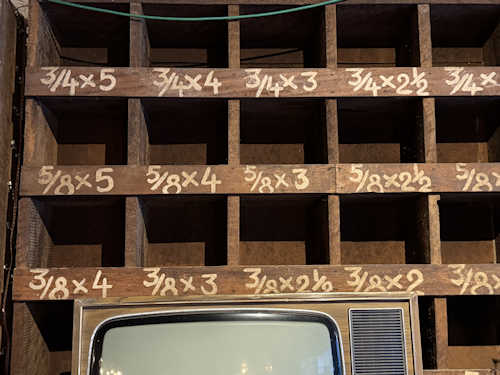
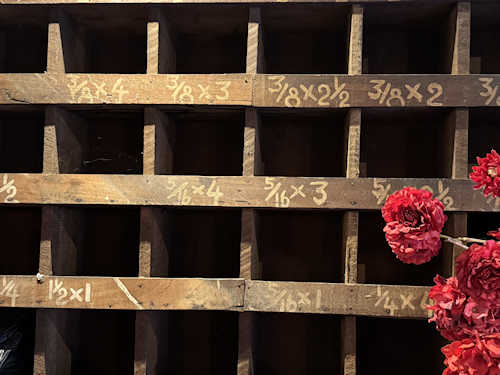

ร้านเมื่อคืน – "Last Night Restaurant", Surat Thani, Thailand
I have recently added a new page to Transum in honour of Henry Ernest Dudeney, the brilliant English puzzle creator whose ideas have inspired so many of the challenges on the site. The page includes a brief account of his life and work, followed by a catalogue of the Dudeney puzzles that have found their way into my personal collection. It is my small way of giving credit to someone whose mathematical imagination continues to entertain, challenge and inspire generations of puzzle solvers.

Talking of Henry, he provided the essence of July's Puzzle of the Month which was:
Mrs Brambleshaw kept a market stall where she sold apples in three sizes: large apples at £1 each, medium apples at two for £1, and small apples at three for £1. Two medium apples weighed the same as one large apple, and three small apples weighed the same as one large apple.
Mr Barnaby Pickles had a large family. He had the same number of boys as girls, and the youngest children were twin boys. Every other child had a birthday in a different month of the year.
He gave his children £7 to spend altogether on apples from Mrs Brambleshaw's stall. If the apples were shared equally by weight among the children, with no apples cut up, how many young Pickles were there?
There were six young Pickles and they each received one medium apple and two small apples. Leonard and Rick have kindly shared their working, as shown below.
That's all for now,
John
P.S. I'm a Maths teacher ... of course I have problems!
Do you have any comments? It is always useful to receive feedback on this newsletter and the resources on this website so that they can be made even more useful for those learning Mathematics anywhere in the world. Click here to enter your comments.
Did you know you can follow this newsletter on Substack completely free of charge? Please note this is separate from a paid subscription to the Transum website, which unlocks a much wider range of premium resources.


Leonard, United States
Thursday, July 2, 2026
"My contribution to this month’s puzzle.
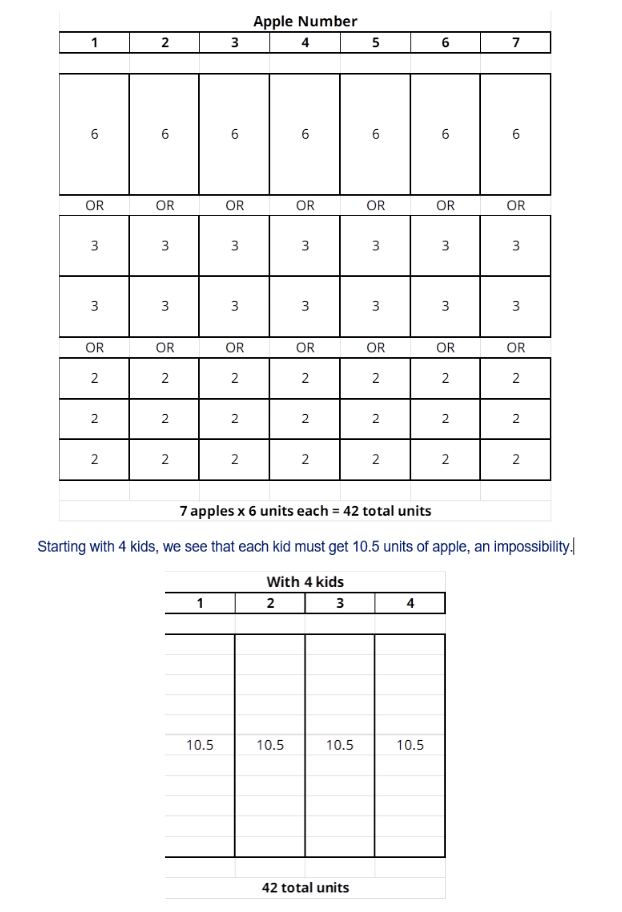
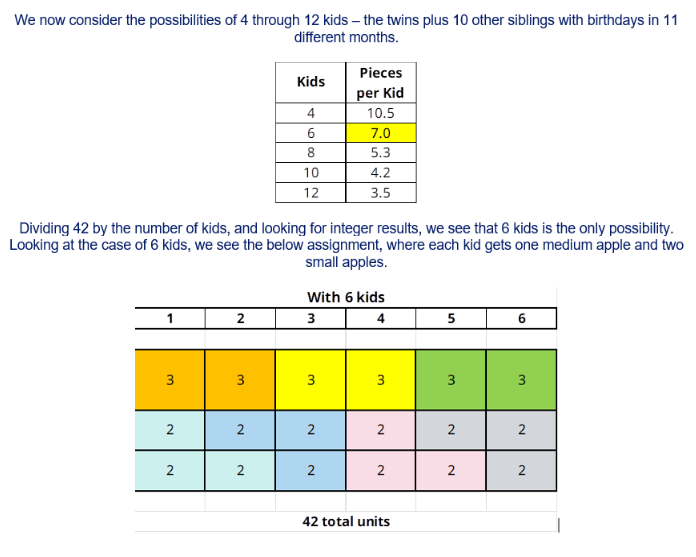 "
"
Thinking of each apple as being left whole, split in half, or split in thirds leads to the following diagram, where each column represents one whole apple, two half apples or three third apples.
We now see that 42 units of apple must be assigned to the kids. .
Rick, USA
Tuesday, July 21, 2026
"First, I assumed that a large apple weighed six ounces. Then a medium apple would weigh three ounces, and a small apple would weigh two ounces. I used a spreadsheet with a formula:
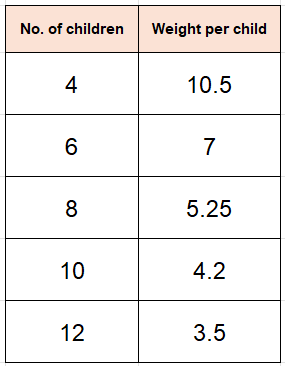
7 × 6 ÷ NoOfChildren
The weight per child had to be an integer (all apples had an integer weight). Only six children had an integer answer. Now, it was just to figure out how to distribute the apples for that particular weight (Two small and one medium per child) to verify the answer."