
Sign In | Starter Of The Day | Tablesmaster | Fun Maths | Maths Map | Topics | More
The April 2026 Transum Newsletter begins in its customary fashion, with the Puzzle of the Month.
Quazmere Quadrant has straight edges of length 24 metres. Inside the quadrant, an orange orchard is shaped like a semicircle, with its diameter lying along one of the quadrant's straight edges and of the same length.
What would be the maximum possible radius of the Green Glade, which is also a semicircle with its diameter along the other straight edge of the quadrant, if it touches, but does not overlap, the orange orchard?

If you get an answer, I'd love to hear how you solved the puzzle or how your students solved it. Fire off an email to: gro.musnarT@rettelsweN
I have always been a fan of having a jolly April Fool's Day joke for my Maths classes on the first day of April. So here is my idea for this year's prank, that you can use too. With a very straight face and serious tone, tell your students that something new has been realised in the world of mathematics:

"Mathematical researchers have recently discovered that when the Ancient Anglicans designed the digits we use today, they did so by drawing shapes with a number of angles equal to the digit's value. For example, the digit '1' contains one angle, '2' contains two angles, and so on."

A larger version, suitable for projection, of this fake news can be found at the bottom of the 1st April Starter of the Day page. Have fun but don't forget to reveal the news as a joke at the end of the morning.
With the April Fool's fun taken care of, here are some of the key resources added to the Transum website during the last month.
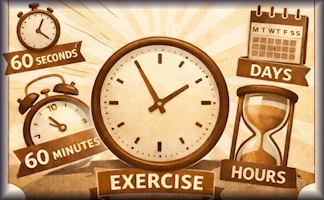
Changing Times is a new activity on Transum that gives students plenty of practise converting between units of time (100 questions in 8 levels). It starts off reassuringly simple (seconds, minutes, hours) and then gently gets its claws in with trickier combinations and formats that tend to trip people up in exams. It’s self-marking, of course, and many of the questions have optional tips on Post-it-style notes. If your classes ever write a perfectly sensible number and forget the units, this one might be worth a look.
Term-to-Term gives students practice with sequences built from a recurrence relation, where each term is found from the one, or sometimes two, before. It starts simply, then becomes a little more thought-provoking, helping learners get used to ideas such as first term, previous term and subsequent term while spotting patterns and following the logic of a sequence step by step.

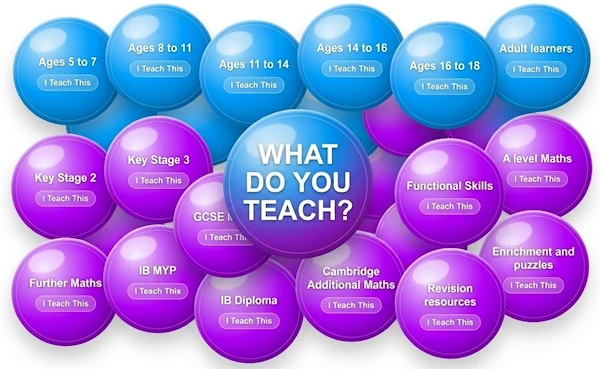
The next new activity is for you! I’d really like to know which age groups and curricula you teach so that I can focus my efforts on creating new resources that will be useful to Transum subscribers. To help with that, I have created what may be the fastest survey in history. It takes about 15 seconds and simply involves clicking on a few bubbles. You will find it on your Members Only page, on the left-hand side near the bottom of the Your Details section. Thanks in anticipation.
Last month I uploaded all 136 of my audio podcasts to YouTube. That may sound a little odd for a platform known mainly for videos, but apparently it is quite a normal thing to do these days. The audio is the main attraction, of course, though listeners will have to make do with a static picture while it plays.
I remember when I was doing my A-levels (Maths, Further Maths and Physics) and having to carry around a well-worn set of log tables and a slide rule. It was around that time that calculators were slowly starting to become available, and this fact horrified some people, who complained that these devices would ruin Maths education if they found their way into the classroom.
As we all know, Maths education was not ruined, and pedagogy developed to incorporate calculators into the curriculum to great effect.
I see history repeating itself in today’s dilemma over the use of AI. This newsletter is not the place for an essay on the new skills and strategies Maths teachers might need to develop, but I certainly think they should make the most of this wonderful new resource.
Much has been said and the question has been asked: particularly if you teach an advanced course, do you know how to tell whether a student’s work is entirely their own, written by AI, or a blend of the two? Furthermore, under what circumstances is the use of AI beneficial to learning?
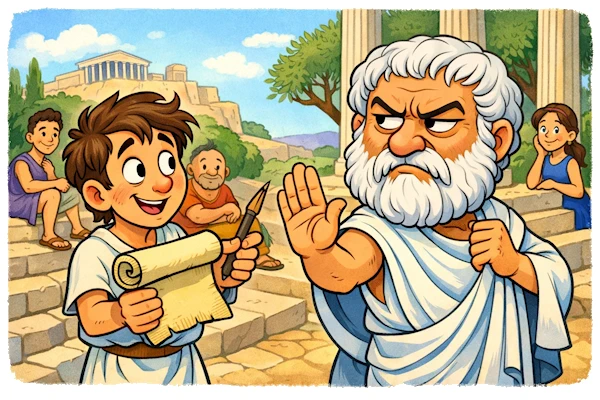
Plato worried that writing would weaken memory
Reassuringly, I have just read an article written by a student at California Polytechnic. He has a very positive attitude and argues it’s just become part of how students learn. They turn to it because they like having an always-available, non-judgmental, infinitely patient tutor that can explain anything in the exact way they need.
He goes on to say we "learn by doing," and believes students understand that if you don’t do it, you don’t learn it.
From his experience, he says it’s obvious that most students are not using ChatGPT to get out of their work. They’re using it to get further into it. To stay curious. To push past confusion. To spend more time on the parts that genuinely interest them.
Have your students yet developed such a commendable attitude, and how confident are you that AI is being used responsibly?
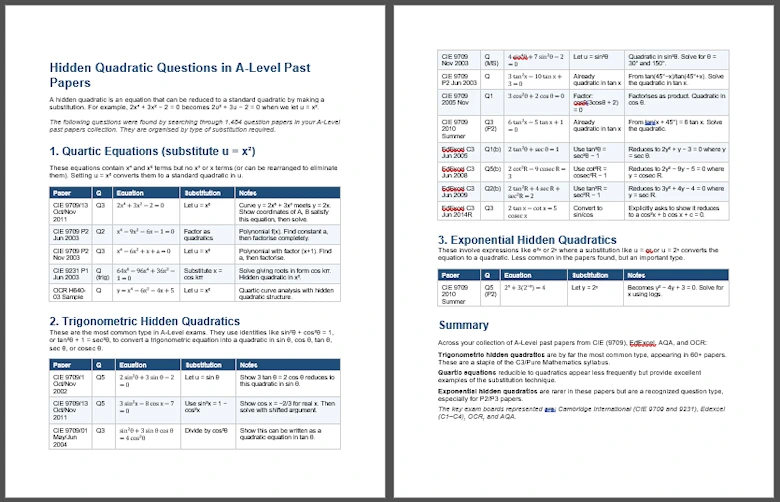
Meanwhile, right here on my computer, I’ve just used Claude Cowork to read my collection of 1,484 A-Level past-paper PDFs and produce a beautifully formatted document categorising the hidden quadratic questions. Absolutely amazing! Which reminds me, I now need to use AI to check the spelling and grammar of this newsletter so that I don’t embarrass myself in front of all you well-educated readers!
Easter Sunday falls on 5 April this year, so this is a good time to mention the collection of Easter-themed maths activities on Transum. There is a nice mixture of puzzles, logic activities, coordinate work, investigations and seasonal challenges, all with a loose Easter connection, making them ideal for the last few lessons before the holiday (if not too late!) or for students to enjoy at home.
Finally, the answer to last month's puzzle which was:
A penguin starts to waddle from a sandcastle to the rocks on a beach at the same time as a crab starts to scuttle from the same rocks heading for the same sandcastle. They pass each other at 11am and the penguin reaches the rocks at 1pm while the crab doesn’t arrive at the sandcastle until 3:30pm.
What time did the waddling and scuttling begin?
The answer is 8am and there is a lovely range of methods in the comments below. Thank you so much to all those who took the time to respond to last month's Puzzle of the Month and I really look forward to the emails I hope to receive about this month's puzzle.
That's all for now,
John
P.S. If you eat chocolate eggs before or after the Easter holiday, you may be guilty of egg-strapolation!
Do you have any comments? It is always useful to receive feedback on this newsletter and the resources on this website so that they can be made even more useful for those learning Mathematics anywhere in the world. Click here to enter your comments.
Did you know you can follow this newsletter on Substack completely free of charge? Please note this is separate from a paid subscription to the Transum website, which unlocks a much wider range of premium resources.


Chris, Scotland
Sunday, March 1, 2026
" "
"
Rick, United States
Sunday, March 1, 2026
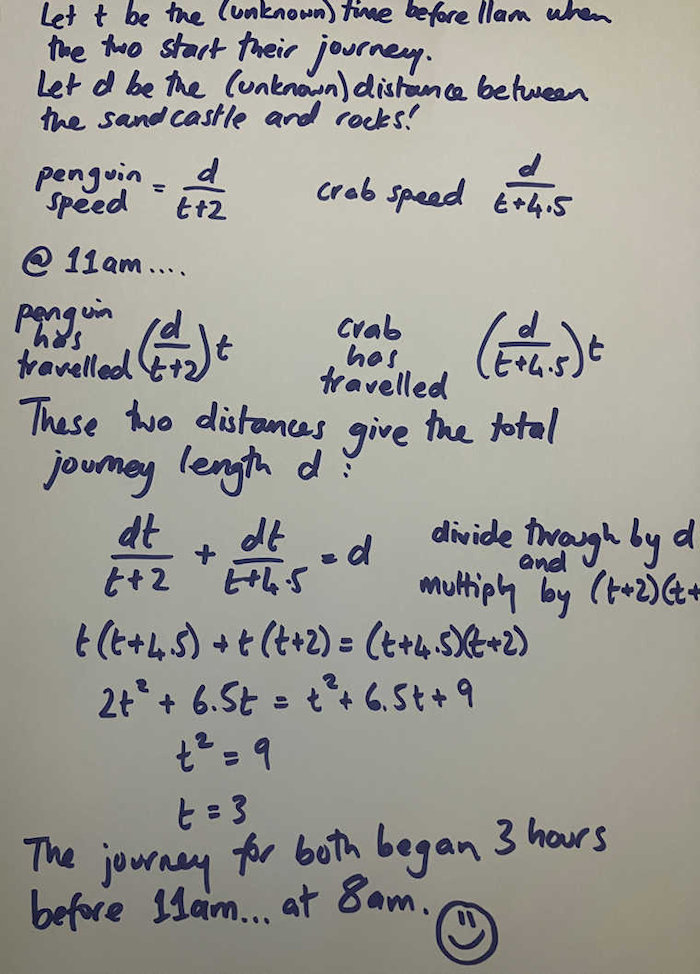
"Here is my answer to the “A Penguin and a Crab” puzzle.
Let d1=distance from sand castle to meeting point.
Let d2=distance from rocks to meeting point.
Let p=waddle speed of penguin
Let c=scuttle speed of the crab.
Let t=time to get to meeting point, which will be the same for both the crab and the penguin.
Then:
(1) p=d1/t
(2) c=d2/t
It took the penguin 2 hours to walk the distance, d2, and the crab 4.5 hours to walk the distance, d1.
(3) p=d2/2
(4) c=d1/4.5
Equating (1) and (3):
(5) d1/t=d2/2
And equating (2) and (4)
(6) d2/t=d1/4.5
Solving both (5) and (6) for d1/d2:
(7) d1/d2=t/2
(8) d1/d2=4.5/t
Equating (7) and (8)
(9) t/2=4.5/t or
(10) t^2=9 or t=3
Since they met at 11 :00AM, this means that they both started their journey at 8:00 AM."
Peter B,
Monday, March 9, 2026
"Hello,
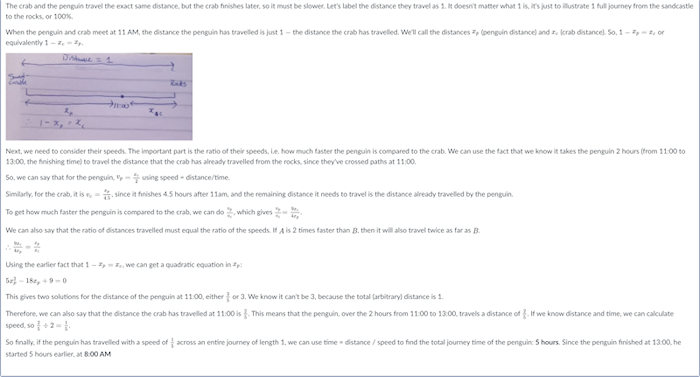
My A-level Further Maths teacher recently shared with us the puzzle from this month's Transum newsletter. After lots of head scratching, I think I've finally come up with a (very algebraic) solution.
My full solution is below.
I don't know if there's an easier way to solve it, but this is where my thought process went! Thanks for the great puzzle.
Sincerely,
Peter B
[Click the image above for a full sized version]"
Leonard, United States
Wednesday, March 11, 2026
"My answer is 8 am. I took a visual approach with the details explained on the visuals.
 "
"