Arithmetic Starters:5.5 Times Table: Write out the 5.5 times table as far as possible. A Thousand and One: Develop a quick way of mentally multiplying any number by 1001. Abundant Buses: A game based around the concept of factors and abundant numbers. Add Quickulations: Calculations appear on the screen every few seconds. This mental arithmetic starter provides pace to the start of the Maths lesson. Addle: Arrange the numbers 1 to 14 in the circles so that the sums are correct. All for 100: Can you write an ex All The Nines: Add up all the multiples of nine in an elegant way. Arithmagons: This lesson starter requires pupils to find the missing numbers in this partly completed arithmagon puzzle. Aunt Sophie's Post Office: Work out the number of stamps needed to post a parcel. Balloon Bursting Buttons: Use only the 1, 5 and 0 keys on a calculator to make given totals. Big Order: Estimate or calculate then put the large numbers in order of size. Blots: The calculations are obscured by ink blots. What do you think the calculations would look like if there were no blots? Broken Calculator (2 and 3): Make the numbers 1 to 10 using only the keys on the broken calculator. Broken Calculator (3 and 4): Some keys are missing from this calculator. Just how useful is it? Broken Calculator (4 and 5): Which numbers can be made with the buttons which have not yet dropped off this calculator? Calc-A-Hundred: A game for two players requiring a calculator and thinking skills. Calculator Nim: A game in which players take turns to add a single-digit number to what is already in the calculator. The winner is the player who makes the display show 30. ClockEquate: Can you use the digits on the left of this clock along with any mathematical operations to equal the digits on the right? Clouds: Some calculations are partly obscured. Work out what those calculations might be. Consecutive: Three consecutive numbers multiplied together give a given product. Pupils are asked to figure out what the numbers are. Consecy Brothers: Which three consecutive numbers multiplied together give the given answer. Countdown: How close can you get to the target by making a calculation from the five numbers given? Cracked Clock: How did the clock break if the numbers on each of the pieces added up to the same total? Cracker Joke: Answer the mental arithmetic questions then convert the answers to letters to find the joke. Cunning Code: Decode the message by doing the calculations given for each letter. Digivide: Arrange the digits 1 to 6 to make a three digit number divided by a two digit number giving a one digit answer. Dimidiate: Arrange the digits from 1 to 9 in alphabetical order. How many times can this number be halved? Division Quickulations: Random division calculations appear on screen every few seconds. Double Trouble: Begin with one, double it, double it again and so on. How many numbers in this sequence can you write down before the register has been called? Eleventh of the Eleventh: Practise multiplying and dividing by eleven in your head. Faulty Button: Find out which of the calculator keys is faulty from the given information. A mathematical puzzle requiring good problem solving strategies. Firewords: Find words which cost 100p if A costs 1p, B costs 2p etc Flabbergasted: If each number in a sequence must be a factor or multiple of the previous number what is the longest sequence that can be made from the given numbers? Flowchart: Use the flowchart to generate a sequence of numbers. Which number will reach 1 the fastest? Fly Catching: Find which whole number divided by another whole number gives the answer: 1.090909091 For Starters: Four problems involving addition, subtraction, multiplication and division For Thought: Add up the answers to the four real life questions. Four Gone: An activity involving a broken calculator which is missing the four button. Can you evaluate the given expressions without using the four? Four Problems: For mathematical questions to get everyone thinking at the beginning of the lesson. Four to Seven: Which of the numbers from one to twenty can you make with the digits 4, 5, 6 and 7? Four's Independence: A clock face containing only the number 4. Can you make a clock face containing any other single number? Half a Dozen: Six calculations to complete without a calculator. Half a Pound: If A costs 1p, B costs 2p, etc can you find a word which costs exactly 50p? Half and Half: Start with 100. Halve it to get 50. Halve that to get 25. Continue as far as possible. Halve it: Start with 512. Halve it to get 256. Halve it to get 128. Continue as far as possible. Happy Numbers: To find out whether a number is happy or not, square each of its digits, add the answers and repeat. If you end up with 1 the number is happy! How many other happy numbers can you find? How Do You Do?: A little lateral thinking will help you solve this number puzzle. How many of Each?: Pens cost 12p each, Pencils cost 9p each, Richard spent 72p altogether. How many pens and pencils did he buy? Inbetween Table: Write down as many multiples of 3.5 as possible in 3.5 minutes. Jeopardy: Loosely based on the famous television show, how many questions cn you come up with for a given answer? Justundera Quid: Find a word whose letters would cost exactly ninety nine pence. Khmer's Homework: Check a student's homework. If you find any of the answers are wrong write down a sentence or two explaining what he did wrong. Know Weigh: Find the weight of one cuboid (by division) of each colour then add your answers together. Letter Clue Calculations: Work out what the calculations might be from the letter clues. Maggots: Do as many of the calculations as possible before the maggots infest! Magic Square: Arrange the numbers 1 to 9 in a 3 by 3 grid to form a magic square. May Day: Add together the dates of all the Thursdays in May this year. Which day sum is largest? Mental Maths Quiz: A traditional twenty question mental arithmetic test presented as a PowerPoint presentation. Mental Maths Test: The starter is a PowerPoint file containing a twenty question mental arithmetic test. It will advance from one question to the next automatically. Meta Products: Which numbers when multiplied by the number of letters in the word(s) of the number give square numbers? Mirror Maths: The bottom half of some symmetrical calculations are shown above. Can you work out the answers? Missing digits: Find which digits are missing from the randomly generated calculations. Missing Pound: A puzzle about a restaurant bill. Exactly where did the missing pound go? Ms Tayke: How many times can you take one number from another? Multi-Toil Panic: Copy and complete the multiplication grid. The higher levels include negative numbers. Multiply Quickulations: Random multiplications appear on screen every few seconds. Nine Digit Sum: Arrange the digits one to nine to make a correct addition calculation. Nine Nine Nine: Arrange the numbers 1-9 to make three 3 digit numbers that add up to 999. No Partner: Find which numbers in a given list do not combine with other numbers on the list to make a given sum. Noodlewhack: Divide one whole number by another on your calculator. If the answer has one digit repeated but no other digits you have a Noodlewhack. On The Double: Double the numbers given in the table. One Digit 100: How many ways can you write an expression for 100 which only uses the same digit repeated and any operations? Only One Number: Find other numbers that can be changed to 1 on a calculator using only the 4 key and any operation. Outnumbered: Which group of four numbers, arranged in a square, has the largest total? Pears Make Squares: Find three numbers such that each pair of numbers adds up to a square number. Pentadd: Five numbers are added together in pairs and the sums shown. What might the five numbers be? PercenTable: Complete the table by calculating common percentages without using a calculator. Pipeline Puzzle: Arrange the numbers so that the totals of the three numbers along any pipe are the same. Plane Numbers: Arrange numbers on the plane shaped grid to produce the given totals Planet Numpair: The sum and product are given, can you find the two numbers? Plant More Trees: If six girls can plant 90 trees in a day. How many trees can ten girls plant in a day? The unitary method. Plus: A number puzzle suitable for children with a wide range of abilities. Plus Four: Work out the answers to the four given sums then add the answers together. Positions Please: Stand at the point between the classroom walls to represent a given number. Product Practice: Work out the answers to the given calculations then add the answers together. There are three different levels of difficulty. Puddings: Complete the calculations with the weights of the puddings Pyramid Puzzle: Arrange numbers at the bottom of the pyramid which will give the largest total at the top. Quotients: Work out the answers to the given division calculations then add the answers together. Recurring Decimal: Use your calculator to find which whole number divided by another whole number gives a recurring decimal. Refreshing Revision: It is called Refreshing Revision because every time you refresh the page you get different revision questions. Render Digitful: Find a calculation for the current year which uses all of the digits 1 to 9. Roman Numerals: Learn a very different method for writing numbers using Roman numerals. Roundabout: Go around the roundabout performing each of the operations. Which starting point gives the largest answer? Rounding 1dp: Round off the given numbers to 1 decimal place then add the answers together. Rounding 2dp: Round off the given numbers to 2 decimal places then add the answers together. Rounding Whole: Round off the given numbers to the nearest whole number then add the answers together. Route to Las Vegas: Work out the cheapest way from Los Angeles to Las Vegas by choosing the best route and adding up the given numbers. Scaramouche: Can you work out from the five clues given what the mystery number is? Second Holiday: Estimate then work out the period of time equal to the given number of seconds. Shadow Sums: Make sums from the three digit numbers given. Sid's Schemes: Work out which is the best scheme for Sid to choose for his summer bonus. One scheme involves a common misconception about percentages. Sign Sequences: Continue the sequences if you can work out the rule. Six Discrimination: An activity involving a calculator which is missing the six button. Can you evaluate the given expressions without using the six? Six of the Best: Six calculations to perform without a calculator. Spin the Wheel: Many basic numeracy questions generated from the number selected by the wheel of fortune. Spinsum: Arrange the numbers on the grid of squares so that the totals along each line of three squares are equal. Square Pairs: Arrange the numbered trees so that adjacent sums are square numbers. Square Thinkers: Can you find three square numbers where the third is the sum of the first two? Stacks of Sums: Write down many different types of calculations which give a particular answer. Stencils: Which of the coloured stencils will fit over the numbered card to produce correct calculations? Strange Tables: A challenge to learn an unfamiliar times table involving decimals. Student Loans: Six students borrow £5000 to help pay for their university course. Calculate how much each student will have to pay back to the lender. Subtract Quickulations: Calculations appear on the screen every few seconds. Sudoku Sum: What is the sum of the numbers missing from the given Sudoku puzzle? Sum Square: Arrange the numbers one to eight into the calculations to make the totals correct.. Sum Story: Make up real life stories for the given calculations. Table Legs: Learn an unusual times table from the strategic finger moving up and down the 'Table Leg'! Targets: Use the given numbers to produce a calculation to get as close as possible to the given target. Tasty Take-Aways: Four subtractions to be done without a calculator. The answers are then to be added together. Team Age: Work out who is in which team from the information given. Three Make 1000: Find three numbers from those given that add up to 1000. How many different sets of three numbers can be found? Three Wise Gifts: Find as many sets of three of the available numbers as possible which add up to the given total. Ticker News: A Think Of A Number problem presented as a news ticker. Time Trials: You have 10 seconds to answer each of the mental arithmetic questions. Timed Tables: How fast can you answer 24 mixed times tables questions? Tool Triangle: Place the numbers on the triangle so that the totals along each of the sides are equal. Triple Totals: Complete the sums using only the given numbers then check your calculations are correct. Triplets: Find as many sets of three of the available numbers as possible which add up to the given total. Two Numbers: Find the two numbers whose sum and product are given. Two Thirds: Make a poster showing a variety of calculations that give the answer two thirds. Unmagic Square: Arrange the numbers 1 to 9 in a 3 by 3 grid so that none of the line totals are the same. Warm Up: Four quick Maths questions to warm up the brain. Weather Report: Find five different integers that multiply together to give a product of twelve. What are they?: A starter about sums, products, differences, ratios, square and prime numbers. Word Difference: Can you find substitutions which will make the word sum correct? Word Sum: Each letter stands for a different digit. Can you make sense of this word sum? Wrong Way Round: Find calculations which written back to front give the same answer.
Small images of these Starters :: Index of Starters Arithmetic Advanced Starters:Animals at the Oasis: Calculate the number of animals gathered at the oasis according to the clues. Barmy BIDMAS: A misleading way of stating the answer to a simple calculation. Divisible by 11: Can you prove that a three digit number whose first and third digits add up to the value of the second digit must be divisible by eleven? Does not add up!: Why would eight and five add up to one? Four Fraction Division: Explain why the answer to a series of fraction divisions is a whole number. Sharing Apples: Share five apples between five children while leaving one in the basket. X Divided by 2Y: Why do different calculators not agree on the order of operations? SuggestedThink of a Number Ten students think of a number then perform various operations on that number. You have to find what the original numbers were.
Curriculum for Arithmetic:Year 5Pupils should be taught to add and subtract whole numbers with more than 4 digits, including using formal written methods (columnar addition and subtraction) more... Pupils should be taught to solve addition and subtraction multi-step problems in contexts, deciding which operations and methods to use and why more... Pupils should be taught to multiply numbers up to 4 digits by a one- or two-digit number using a formal written method, including long multiplication for two-digit numbers more... Pupils should be taught to divide numbers up to 4 digits by a one-digit number using the formal written method of short division and interpret remainders appropriately for the context more... Pupils should be taught to multiply and divide whole numbers and those involving decimals by 10, 100 and 1000 more... Pupils should be taught to solve problems involving addition, subtraction, multiplication and division and a combination of these, including understanding the meaning of the equals sign more... Year 6Pupils should be taught to multiply multi-digit numbers up to 4 digits by a two-digit whole number using the formal written method of long multiplication more... Pupils should be taught to divide numbers up to 4 digits by a two-digit whole number using the formal written method of long division, and interpret remainders as whole number remainders, fractions, or by rounding, as appropriate for the context more... Pupils should be taught to divide numbers up to 4 digits by a two-digit number using the formal written method of short division where appropriate, interpreting remainders according to the context more... Pupils should be taught to use their knowledge of the order of operations to carry out calculations involving the four operations more... Pupils should be taught to solve addition and subtraction multi-step problems in contexts, deciding which operations and methods to use and why more... Pupils should be taught to identify the value of each digit in numbers given to three decimal places and multiply and divide numbers by 10, 100 and 1000 giving answers up to three decimal places more... Pupils should be taught to solve problems involving addition, subtraction, multiplication and division more... Pupils should be taught to multiply one-digit numbers with up to two decimal places by whole numbers more... Pupils should be taught to use written division methods in cases where the answer has up to two decimal places more... Years 7 to 9Pupils should be taught to use the four operations, including formal written methods, applied to integers, decimals, proper and improper fractions, and mixed numbers, all both positive and negative more... Pupils should be taught to use conventional notation for the priority of operations, including brackets, powers, roots and reciprocals more... Feedback:Comment recorded on the 3 October 'Starter of the Day' page by S Mirza, Park High School, Colne: "Very good starters, help pupils settle very well in maths classroom." Comment recorded on the 12 July 'Starter of the Day' page by Miss J Key, Farlingaye High School, Suffolk: "Thanks very much for this one. We developed it into a whole lesson and I borrowed some hats from the drama department to add to the fun!" Comment recorded on the 10 September 'Starter of the Day' page by Carol, Sheffield PArk Academy: "3 NQTs in the department, I'm new subject leader in this new academy - Starters R Great!! Lovely resource for stimulating learning and getting eveyone off to a good start. Thank you!!" Comment recorded on the 25 June 'Starter of the Day' page by Inger.kisby@herts and essex.herts.sch.uk, : "We all love your starters. It is so good to have such a collection. We use them for all age groups and abilities. Have particularly enjoyed KIM's game, as we have not used that for Mathematics before. Keep up the good work and thank you very much Comment recorded on the 28 May 'Starter of the Day' page by L Smith, Colwyn Bay: "An absolutely brilliant resource. Only recently been discovered but is used daily with all my classes. It is particularly useful when things can be saved for further use. Thank you!" Comment recorded on the 1 May 'Starter of the Day' page by Phil Anthony, Head of Maths, Stourport High School: "What a brilliant website. We have just started to use the 'starter-of-the-day' in our yr9 lessons to try them out before we change from a high school to a secondary school in September. This is one of the best resources on-line we have found. The kids and staff love it. Well done an thank you very much for making my maths lessons more interesting and fun." Comment recorded on the s /Indice 'Starter of the Day' page by Busolla, Australia: "Thank you very much for providing these resources for free for teachers and students. It has been engaging for the students - all trying to reach their highest level and competing with their peers while also learning. Thank you very much!" Comment recorded on the 7 December 'Starter of the Day' page by Cathryn Aldridge, Pells Primary: "I use Starter of the Day as a registration and warm-up activity for my Year 6 class. The range of questioning provided is excellent as are some of the images. Comment recorded on the 6 May 'Starter of the Day' page by Natalie, London: "I am thankful for providing such wonderful starters. They are of immence help and the students enjoy them very much. These starters have saved my time and have made my lessons enjoyable." Comment recorded on the 5 April 'Starter of the Day' page by Mr Stoner, St George's College of Technology: "This resource has made a great deal of difference to the standard of starters for all of our lessons. Thank you for being so creative and imaginative." Comment recorded on the 9 October 'Starter of the Day' page by Mr Jones, Wales: "I think that having a starter of the day helps improve maths in general. My pupils say they love them!!!" Comment recorded on the 14 September 'Starter of the Day' page by Trish Bailey, Kingstone School: "This is a great memory aid which could be used for formulae or key facts etc - in any subject area. The PICTURE is such an aid to remembering where each number or group of numbers is - my pupils love it! Comment recorded on the 24 May 'Starter of the Day' page by Ruth Seward, Hagley Park Sports College: "Find the starters wonderful; students enjoy them and often want to use the idea generated by the starter in other parts of the lesson. Keep up the good work" Comment recorded on the 19 June 'Starter of the Day' page by Nikki Jordan, Braunton School, Devon: "Excellent. Thank you very much for a fabulous set of starters. I use the 'weekenders' if the daily ones are not quite what I want. Brilliant and much appreciated." Comment recorded on the 3 October 'Starter of the Day' page by Mrs Johnstone, 7Je: "I think this is a brilliant website as all the students enjoy doing the puzzles and it is a brilliant way to start a lesson." Comment recorded on the 19 October 'Starter of the Day' page by E Pollard, Huddersfield: "I used this with my bottom set in year 9. To engage them I used their name and favorite football team (or pop group) instead of the school name. For homework, I asked each student to find a definition for the key words they had been given (once they had fun trying to guess the answer) and they presented their findings to the rest of the class the following day. They felt really special because the key words came from their own personal information." Comment recorded on the 23 September 'Starter of the Day' page by Judy, Chatsmore CHS: "This triangle starter is excellent. I have used it with all of my ks3 and ks4 classes and they are all totally focused when counting the triangles." Comment recorded on the 28 September 'Starter of the Day' page by Malcolm P, Dorset: "A set of real life savers!! Comment recorded on the 16 March 'Starter of the Day' page by Mrs A Milton, Ysgol Ardudwy: "I have used your starters for 3 years now and would not have a lesson without one! Fantastic way to engage the pupils at the start of a lesson." Comment recorded on the 14 October 'Starter of the Day' page by Inger Kisby, Herts and Essex High School: "Just a quick note to say that we use a lot of your starters. It is lovely to have so many different ideas to start a lesson with. Thank you very much and keep up the good work." Comment recorded on the 18 September 'Starter of the Day' page by Mrs. Peacock, Downe House School and Kennet School: "My year 8's absolutely loved the "Separated Twins" starter. I set it as an optional piece of work for my year 11's over a weekend and one girl came up with 3 independant solutions." Comment recorded on the 8 May 'Starter of the Day' page by Mr Smith, West Sussex, UK: "I am an NQT and have only just discovered this website. I nearly wet my pants with joy. Comment recorded on the 2 May 'Starter of the Day' page by Angela Lowry, : "I think these are great! So useful and handy, the children love them. Comment recorded on the 17 June 'Starter of the Day' page by Mr Hall, Light Hall School, Solihull: "Dear Transum, Comment recorded on the 19 November 'Starter of the Day' page by Lesley Sewell, Ysgol Aberconwy, Wales: "A Maths colleague introduced me to your web site and I love to use it. The questions are so varied I can use them with all of my classes, I even let year 13 have a go at some of them. I like being able to access Starters for the whole month so I can use favourites with classes I see at different times of the week. Thanks." Comment recorded on the 3 October 'Starter of the Day' page by Fiona Bray, Cams Hill School: "This is an excellent website. We all often use the starters as the pupils come in the door and get settled as we take the register." Comment recorded on the s /Coordinate 'Starter of the Day' page by Greg, Wales: "Excellent resource, I use it all of the time! The only problem is that there is too much good stuff here!!" Comment recorded on the 9 May 'Starter of the Day' page by Liz, Kuwait: "I would like to thank you for the excellent resources which I used every day. My students would often turn up early to tackle the starter of the day as there were stamps for the first 5 finishers. We also had a lot of fun with the fun maths. All in all your resources provoked discussion and the students had a lot of fun." Comment recorded on the 21 October 'Starter of the Day' page by Mr Trainor And His P7 Class(All Girls), Mercy Primary School, Belfast: "My Primary 7 class in Mercy Primary school, Belfast, look forward to your mental maths starters every morning. The variety of material is interesting and exciting and always engages the teacher and pupils. Keep them coming please." Comment recorded on the 26 March 'Starter of the Day' page by Julie Reakes, The English College, Dubai: "It's great to have a starter that's timed and focuses the attention of everyone fully. I told them in advance I would do 10 then record their percentages." |
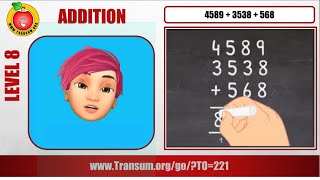
Notes:The ability to perform mathematical calculations is still very important despite our hi-tech environment. Good numeracy skills support the understanding of more advanced mathematical concepts at all levels. Mathematicians still consider mastery of the manual algorithms to be a necessary foundation for the study of algebra and computer science. Arithmetic Teacher Resources:Column Method for Addition: Practise your addition skills with this exercise that already has the calculation set out for you. Formal Written Methods: Examples of formal written methods for addition, subtraction, multiplication and division. Column Method for Multiplication: Practise your multiplication skills with this exercise that already has the calculation set out for you. Countdown: How close can you get to the target by making a calculation out of the five numbers given? Long Division: Practise long division with this exercise that already has the calculation set out for you. Just In Time: Every 10 seconds a new calculation appears on the screen: A dynamic visual aid. Maths Bingo: This application will pick the bingo numbers for you and present each of the numbers as a mathematical expression. Divisibility Tests 2-12: A visual aid designed to be projected in the classroom. Here you can find the quick ways of telling whether a number is exactly divisible by the numbers two to twelve. Quickulations: A mental arithmetic visual aid that displays random calculations then after a few seconds displays the answers. Short Division: Practise short division with this exercise that already has the calculation set out for you. Word Sums Guide: A step by step guide showing how to solve a Word Sum where each letter stands for a different digit. Arithmetic Activities:Think of a Number: Ten students think of a number then perform various operations on that number. You have to find what the original numbers were. Basic Addition: A self-marking exercise on addition with increasing levels of difficulty. Fifteen: A strategy game. Play against the computer to select three numbers that add up to 15. Column Method for Addition: Practise your addition skills with this exercise that already has the calculation set out for you. Basic Subtraction: A self-marking exercise on subtraction with increasing levels of difficulty. Times Tables: A collection of activities to help you learn your times tables in only 5 days. Fast Factors: Match the numbers with the answer to the times table. A timed activity to improve instant recall of key table facts. BIDMAS: A self marking exercise testing the application of BIDMAS, an acronym describing the order of operations used when evaluating expressions. Basic Multiplication: A self-marking exercise on multiplication with increasing levels of difficulty. BIDMAS Game: An online interactive game celebrating the order of mathematical operations. Basic Division: A self-marking exercise on dividing numbers of up to four digits by one or two-digit whole numbers using the formal written methods of short and long division 23 or Bust: A game involving mental arithmetic and strategy for two players or one player against the computer. Addle: Arrange the numbers from 1 to 14 in the spaces to make the sums correct. How fast can you do it? Four Sum: Arrange the given number tiles to make two 2 digit numbers that add up to the given total. Clouds: Can you work out which numbers are hidden behind the clouds in these calculations? Brainbox: A puzzle requiring the arrangement of numbers on the function machines to link the given input numbers to the correct output. Broken Calculator: Some of the buttons are missing from this calculator. Can you make the totals from 1 to 20? Stepwise Sums: Arrange the numbers one to nine on the stairs to obtain the given sums. Chain Challenge: How fast can you perform all of the given operations without using a calculator? Column Method for Multiplication: Practise your multiplication skills with this exercise that already has the calculation set out for you. Multitude: Arrange the given digits to make three numbers such that the third is the product of the first and the second. Palindrome Products: Use long multiplication and pattern spotting to fill in the table with palindromic products. Nine Digits: Arrange the given digits to make three numbers such that two of them add up to the third. Long Division: Practise long division with this exercise that already has the calculation set out for you. Beat The Clock: It is a race against the clock to answer 30 mental arithmetic questions. There are nine levels to choose from. Discombobulated: A fun game requiring you to find numbers which add up to the target number as quickly as possible. Divides Exactly: Find which divisions result in whole number quotients. A mental arithmetic speed challenge. Doubling Quiz: Drag the number cards onto their doubles. No calculators or writing allowed. Equatero: Find the expression from a series of guesses and clues. Arithmagons: Find the missing numbers in these triangular, self-checking puzzles and discover the wonders of these fascinating structures. Decimal Plus: Practise mental and written methods for adding and subtracting decimal numbers. Decimal Times: Practise mental and written methods for multiplying and dividing decimal numbers. Furthermore: A self-marking exercise on counting forwards or backwards in tens, hundreds, thousands etc. How Many of Each?: Work out how many items were bought from the information given. Yohaku Puzzles: Fill in the blank spaces so that the cells give the sum or the product shown in each row and column. Know Your Place: Without a calculator perform some calculations requiring a knowledge of place value. Largest Product: A drag and drop activity challenging you to arrange the digits to produce the largest possible product. Letter Sums: Use your mental arithmetic skills to add up the values of the letters in these mathematical words. Ludicross: Arrange the given numbers on the cross so that the sum of the numbers in both diagonals is the same. Magic Square: Each row, column and diagonal should produce the same sum. Make 1000: Use the numbers on the strange calculator to make a total of 1000 Make an expression: Use the digits given to form an expression equivalent to the given total. Masad: For each pair of numbers subtract the sum from the product then divide the result by 20 without a calculator. Missing Operations Exercise: Each box represents a missing operation (add, subtract, multiply or divide). What are they? Mixpressions: Arrange the cards to create a valid mathematical statement. Huge Numbers: Carry out calculations with numbers up to one million including strategies to check answers. Multi-step Problems: Solve multi-step problems in contexts, deciding which operations and methods to use and why. Nine Nine Nine: Use the digits 1 to 9 to make three 3 digit numbers which add up to 999. No Partner: Find which numbers in a given list do not combine with other numbers on the list to make a given sum. Numbasics: A daily workout strengthening your ability to do the basic mathematical operations efficiently. Centexpression: Arrange the numbers from 1 to 9 to make an expression with a value of 100. Number Skills Inventory: A checklist of basic numeracy techniques that every pupil should know. Standard Form: Test your understanding of standard form (scientific notation) with this self-marking quiz. Sum of Three Palindromes: Every whole number can be expressed as the sum of three palindromic numbers like this... Numerate: Earn points by creating equations on the grid in this game of equations. Numskull: Interactive, randomly-generated, number-based logic puzzle designed to develop numeracy skills. One Digit Only: Find expressions using only one digit which equal the given targets. Partial Pyramids: Calculate the missing numbers in these partly completed pyramid puzzles. Pentadd Quiz: Find the five numbers which when added or multiplied together in pairs to produce the given sums or products. Pentransum: Mathematical questions with five possible answers. If you get 20 correct you can add your own question to the database. Pick Up Sticks: If you were to pick up the sticks from this pile so that you were always removing the top stick what calculation would you create? Plane Numbers: Arrange numbers on the plane shaped grid to produce the given totals Plus: A number arranging puzzle with seven levels of challenge. Powten: Practise multiplying and dividing by powers of ten without using a calculator. Pyramid Puzzle: Numbers in the bricks are found by adding the two bricks immediately below together. Can you achieve the given target? Quick: Can you multiply a number by 1001 in your head? This exercise provides practice in this and other similar challenges. Remainder Race: A game involving chance and choice requiring an ability to calculate the remainder when a two digit number is divided by a single digit number. Roman Numerals Quiz: This online, self marking quiz tests your ability to convert Roman numerals. Six Keys: Use just six keys on your calculator to make a given total. How many different ways can it be done? Short Division: Practise short division with this exercise that already has the calculation set out for you. Six Discrimination: The six button has dropped off! How could these calculations be done using this calculator? Spinsum: Arrange the numbers on the squares so that the totals along each line of three squares are equal. Stamp Sticking: Drag stamps onto the envelopes to make the exact postage as shown at the top left of each envelope. Suko Sujiko: Interactive number-based logic puzzles similar to those featuring in daily newspapers. Bidmaze: Find your way through the maze encountering mathematical operations in the correct order to achieve the given total. Sum Game: A game against the clock to find the numbers which add up to the target number. Partition Clues: Partition numbers in different ways according to the clues given. The higher levels are quite hard! TablesMaster: How fast can you answer times table questions? This activity provides feedback to help you improve. Digital Darts: An online darts game for one or two players requiring skill, strategy and mental arithmetic. The Miller's Puzzle: This is an interactive version of the puzzle described by Henry Ernest Dudeney in The Canterbury Puzzles Tools: In how many different ways can the numbers be arranged to give the same totals? Triplets: Find as many sets of three of the available numbers as possible which add up to the given total. Tug of War: A game for two players or teams testing their speedy reactions to mental arithmetic questions. Perfect Magic Square: Arrange the sixteen numbers on the four by four grid so that groups of four numbers in a pattern add up to the same total. Unmagic Square: Like the magic square but all of the totals should be different. Which Operation?: Decide which mathematical operation is required then use it to find the answers. Zygo: Interactive, randomly-generated, number-based logic puzzle designed to develop numeracy skills. Magic Square Puzzle: Find all of the possible ways of making the magic total from the numbers in this four by four magic square. Digivide: Arrange the numbers from 1 to 6 in the spaces to make the division calculation correct. Heptaphobia Research: Use written methods to answer ten arithmetic questions. When you have finished you will find the results of this amazing research. Some Sums and Products: Number puzzles involving adding, multiplying and problem solving Finally there is Topic Test, a set of 10 randomly chosen, multiple choice questions suggested by people from around the world. Arithmetic Investigations:Aunt Sophie's Post Office: Investigate the ways of making up various postage amounts using 3p and 8p stamps. An online stamp calculator is provided for you to check your working. The Four Rules: See if you can make all of the numbers from 0 to 10 using four threes Cosmic Redshift: Investigate the number found by performing an algorithm on a three digit number. Decimal Products: Find two decimal numbers that add up to exactly one. What is the product of these two decimals? Arithmetic Videos:Addition Video: A reminder of how to add two or more numbers using the column method. BIDMAS Video: A reminder of the order of operations often referred to as BIDMAS, BODMAS or PEMDAS. Division Video: A reminder of how to divide one number into another using short or long division. Misconceptions: Some people have some strange ideas about multiplication and division. Multiplication: A different way to multiply together numbers. Can you see how it works? Multiplication Methods: Can you understand the explanation of these multiplication methods even though you may not speak the teacher's language? Multiplication Song: Wako shows how to multiply 47 by 83 in his crazy cartoon singing way! Multiplication Video: A reminder of how to multiply two numbers using the column method or long multiplication. BIDMAS Misconception: This Maths problem went viral on Twitter and there has been debate about the answer. Presh explains why one interpretation is considered correct. Subtraction Video: A reminder of how to subtract one number from another using the column method. Arithmetic Worksheets/Printables:Game Board for 23 or Bust: A printable game board for 23 or Bust. Choose your own object to serve as the lifesaver such as a pencil sharpener, a rubber or a coin. Strategy for 23 or Bust: A printable worksheet containing a table to be filled in with the best moves for the game 23 or Bust. Divisibility Tests Worksheet: This worksheet contains a list of the divisibility tests along with a fill-in-the-table exercise. Maggots Template: A blank Maggots screen designed for pupils to record their answers on for the Maggots Starter activity. Missing Operations Worksheet: Each box represents a missing operation (add, subtract, multiply or divide). Can you work out what they are? Pyramid Worksheet: Put the numbers 1 to 5 in the bottom row of the pyramid then each other brick is the sum of the two below. Take Sides Questions: Thirty pairs of numbers or calculations. Which one of the pair is the largest? Arithmetic External Links:Links to other websites containing resources for Arithmetic are provided for those logged into 'Transum Mathematics'. Subscribing also opens up the opportunity for you to add your own links to this panel. You can sign up using one of the buttons below: SearchThe activity you are looking for may have been classified in a different way from the way you were expecting. You can search the whole of Transum Maths by using the box below.
OtherIs there anything you would have a regular use for that we don't feature here? Please let us know. SuggestedSome Sums and Products Number puzzles involving adding, multiplying and problem solving
|
Teaching Notes:Many Transum activities have notes for teachers suggesting teaching methods and highlighting common misconceptions. There are also solutions to puzzles, exercises and activities available on the web pages when you are signed in to your Transum subscription account. If you do not yet have an account and you are a teacher, tutor or parent you can apply for one by completing the form on the Sign Up page. A Transum subscription also gives you access to the 'Class Admin' student management system, downloadable worksheets, many more teaching resources and opens up ad-free access to the Transum website for you and your pupils. | |
CommentsHave today's Starter of the Day as your default homepage. Copy the URL below then select Set as your homepage (if you are using Internet Explorer)
Do you have any comments? It is always useful to receive feedback and helps make this free resource even more useful for those learning Mathematics anywhere in the world. Click here to enter your comments. |
|