Topics: Starter | Logic | Mixed | Multiple Intelligences | Puzzles
How did you use this starter? Can you suggest
how teachers could present or develop this resource? Do you have any comments? It is always useful to receive
feedback and helps make this free resource even more useful for Maths teachers anywhere in the world.
Click here to enter your comments.
Previous Day | This starter is for 6 May | Next Day
Your access to the majority of the Transum resources continues to be free but you can help support the continued growth of the website by doing your Amazon shopping using the links on this page. Below is an Amazon link. As an Amazon Associate I earn a small amount from qualifying purchases which helps pay for the upkeep of this website.
Educational Technology on Amazon


|
Teacher, do your students have access to computers such as tablets, iPads or Laptops? This page was really designed for projection on a whiteboard but if you really want the students to have access to it here is a concise URL for a version of this page without the comments: Transum.org/go/?Start=May6 However it would be better to assign one of the student interactive activities below. |
|
Here is the URL which will take them to a related student activity.

If you randomly select one of the possible answers to this multiple choice question what is the probability you are correct?
a) 20%
b) 40%
c) 60%
d) 20%
e) 0%


I ALWAYS
TELL LIES
In 1901, the British philosopher and mathematician Bertrand Russell uncovered a possible paradox that necessitated a modification to set theory. One version of Russell's Paradox involves a town with one male barber who, every day, shaves every man who doesn't shave himself, and no one else. Does the barber shave himself?
From The Math Book published by Sterling
Interesting number paradox
Did you know that all numbers are interesting?
Proof: Assume there exists a set of uninteresting numbers. This set would have a smallest number, which is interesting because it is the smallest uninteresting number. But a number cannot be both interesting and uninteresting, so the assumption that there exists a set of uninteresting numbers must be wrong and hence, all numbers must be interesting.
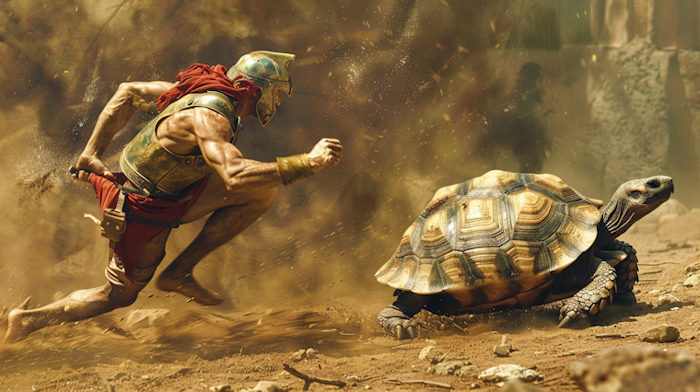
The image above is inspired by another famous paradox. If you don't know it you could do a little research.
Clue: the man is known as Achilles.