
Sign In | Starter Of The Day | Tablesmaster | Fun Maths | Maths Map | Topics | More
This is the Transum Newsletter for the month of October 2026. It begins, as usual, with the puzzle of the month.
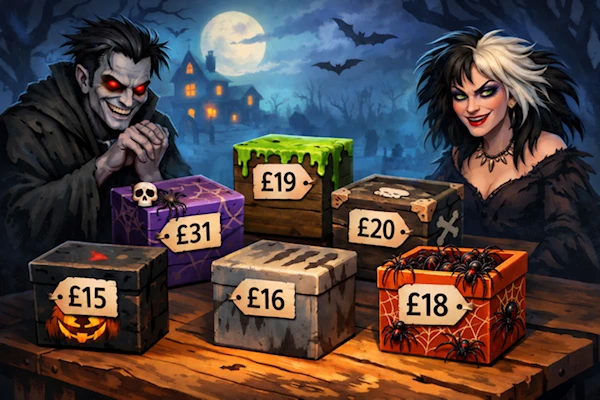
At Halloween, a shopkeeper bought six boxed surprises. One box contained treats, while the other five contained horrible tricks. Written clearly on the boxes were these prices: £15, £31, £19, £20, £16 and £18.
He kept the box of treats for himself, but sold all five trick boxes to two customers called Morbid and Cruella.
The total price of the boxes bought by Morbid came to exactly twice the total price of the boxes bought by Cruella.
What was the cost of the box containing the treats?
If you get an answer, I'd love to hear how you solved the puzzle or how your students solved it. Fire off an email to gro.musnarT@rettelsweN
While you think about that, here are some of the key resources added to the Transum website during the last month.
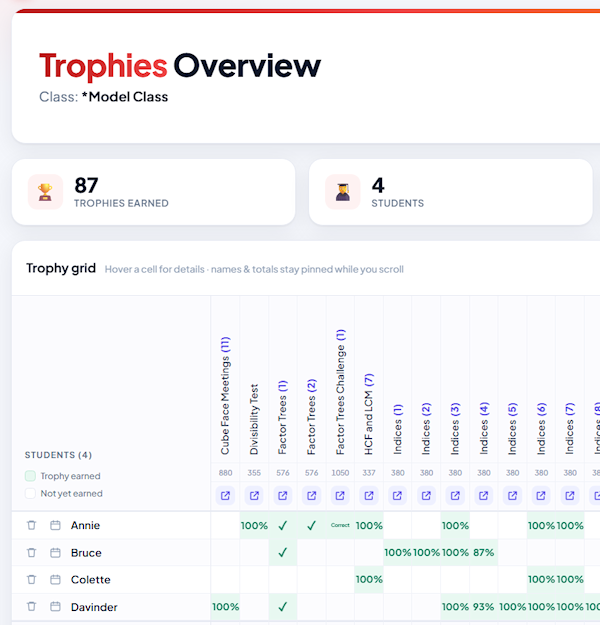
Firstly, I'm pleased to announce that the teachers' overview page in Class Admin, showing the trophies your students have earned, has been given a major facelift. It's now easier than ever to keep track of your students' progress. The Markbook page has also been updated with lots of new features.
Quadratic Gaps is a new set of exercises designed to come before the quadratic sequences exercise. It focuses on the first and second differences of the terms of a quadratic sequence and how these can be used to predict other terms even without the use of a formula.
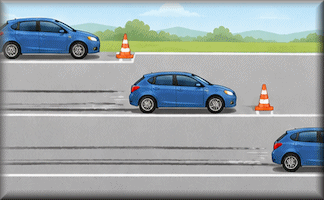
Conversion Graphs is a new twelve-level exercise ranging from familiar unit conversions to car park charges, cooling coffee and braking distances. Each level features a different graph, with challenges including step graphs, extrapolation and curves. The currency graph even updates using live exchange rates! Animated worked examples offer help along the way. Suitable for Key Stage 3 through to GCSE, it provides plenty of variety for classwork or homework.
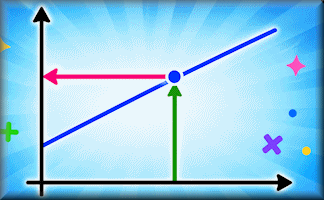
Now here's a linguistic curiosity that I've never considered before. In English, many ordinal numbers do double duty. The same word is used to describe a position in a sequence as well as a fractional part of a whole.
It came to mind as I was creating the advanced starter called Mean of the Twelfth Terms.
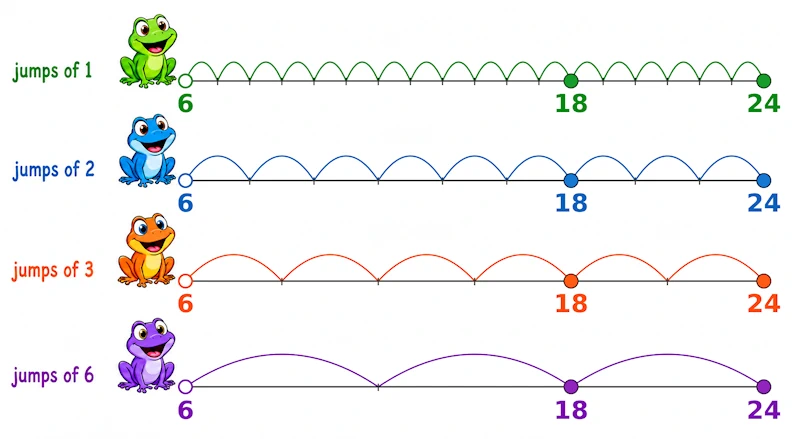
The new Angle Names activity gives students practice in recognising acute, obtuse and reflex angles in a variety of forms. Across three levels, students identify these angle types from colourful pictures of everyday situations, from more traditional mathematical diagrams, and from angles given by their size in degrees. Designed for Year 5 and above, the activity provides an engaging way to build confidence with this essential vocabulary. Being able to recognise and classify angles accurately is an important foundation before students move on to measuring, calculating and reasoning with angles in more advanced geometry.

Parallel and Perpendicular is a four-level exercise, not too serious, encouraging pupils to recognise parallel and perpendicular lines. That's about it.
A number of people have mentioned the classic Towers puzzle, sometimes known as the Skyscraper puzzle, to me over the years. I always thought that, as other websites already offered it, there was no real need to add it to Transum. But as technology has advanced and my ability to use it has grown, I’ve realised how useful an interactive 3D version could be, allowing students to see the towers from different viewpoints. I’m quite pleased with how it’s turned out and encourage you to have a go at the Towers puzzle for yourself.
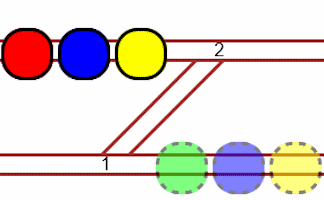
Shunting Puzzles has been given a complete visual overhaul with updated graphics. The puzzles are unchanged, so existing best times still stand. This one is not explicitly mathematical, and that is rather the point: it asks for abstract thought, logical deduction and a strategy worked out several moves ahead, which is precisely what a good multi-step problem demands. The activity records each student's best time, so there is always a reason to try again. Two further levels are available beyond the ten shown on the tabs, and they only appear for those who earn the trophies to unlock them.
A new on-screen calculator has been designed as a visual aid for teachers. It can be projected onto a whiteboard for whole-class teaching or used during online tuition, where its display can be shown or shared with students.
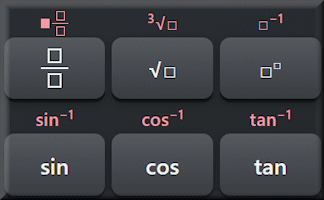
It is designed to resemble the scientific calculators commonly used in UK secondary schools and includes many of the functions students are likely to need. However, it does not reproduce every feature of a modern handheld scientific calculator.
🎃 🎃 🎃
Halloween haunts the world at the end of this month, and of course there are a number of mathematically linked activities here on Transum. There’s a Starter to use with the whole class. Then there are lots of individual student activities such as Trick or Treat, Midnight Magic Mixture and the brand-new One Pumpkin Each. You can find them all on the new Halloween Activities page.
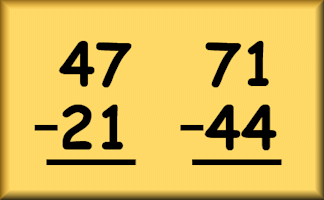
There’s only one thing I don’t like about Halloween... which is...
While you think about that (say it out loud), I'll let you know about some other dates in October with a loose mathematical connection:
Don't forget you can listen to this month's podcast, which is the audio version of this newsletter. You can find it here, on Spotify, YouTube or on Apple Podcasts. You can follow Transum on Bluesky, Twitter (some call it X) and 'like' Transum on Facebook.
I was fascinated to read that OpenAI has published a proposed solution to the Navier-Stokes existence and smoothness problem, one of the seven Millennium Prize Problems established by the Clay Mathematics Institute. The proof was produced by an unreleased OpenAI system and has also been formally verified using the Lean proof assistant. The Clay Mathematics Institute has since said that the problem has "apparently been settled", although its formal evaluation of the result is still under way. Only one of the seven Millennium Prize Problems has previously been solved, so if the proof is accepted this would be an extraordinary milestone for both mathematics and artificial intelligence.
Finally, the answer to last month's puzzle, which was:
It’s a long way to Tipperary and the taxi fare for the return journey, there and back, is £45. Two-thirds of the way there, the taxi picks up Mr Pernickety and his large suitcase; it drops them off one-third of the way back. If the suitcase counts as an extra person, what is the fairest way for Mr Pernickety and me to share the fare?
The notion of fairness is subjective, but assuming the fare is proportional to distance travelled, this is how I see it:
I do two-thirds of the journey alone, so I should pay for that portion of the journey: £30. The remaining £15 is shared equally between three: Mr Pernickety, his suitcase and me, at £5 each. So I pay £35, and Mr Pernickety pays £10 for himself and his suitcase.
My first, incorrect solution was: I do six sixths of the journey. Mr. Pernickety does two sixths of the journey and his suitcase does two sixths of the journey. So the amount we pay should be in the ratio of 6:4. Thinking of it that way, I pay £27 and he pays £18.
The flaw in the 6:4 method is especially clear because it asks Mr Pernickety to pay £18, even though the entire portion of the taxi journey for which he and his suitcase are present costs only £15. In effect, he is contributing £3 towards the sections I travel alone.
That's all for now,
John
P.S. Most numbers are very large.
Do you have any comments? It is always useful to receive feedback on this newsletter and the resources on this website so that they can be made even more useful for those learning Mathematics anywhere in the world. Click here to enter your comments.
Did you know you can follow this newsletter on Substack completely free of charge? Please note this is separate from a paid subscription to the Transum website, which unlocks a much wider range of premium resources.


Rick, United States
Friday, September 4, 2026
"I had several false starts, each resulting in a different answer. This reminded me of a joke that I heard as a child.
Johnny was extremely happy and it must have shown on his face. When his mat teacher, Mr. Peabody, walked into class, he noticed Johnny’s expression and asked him what he was so happy about. He replied that he really had a lot of fun solving the homework problem assigned the previous day. In fact, he had so much fun that he tried ten different methods to solve the problem. Mr. Peabody exclaimed, “That’s great Johnny. I am impressed with your diligence and enthusiasm,” to which, as he handed Mr. Peabody a paper, Johnny replied, “and hear are the ten answers, each different from each other.
Solution
Because passenger changes on boundaries of thirds and it is a roundtrip, First, I divided the trip into six segments labeled segment 1, segment 2, … segment 6. Segment 1 is the first third of the outbound portion of the trip. Segment 2 is the second third and segment 3 is the last third of the outbound trip. Segment 4 is the first third of the return trip, segment 5 the middle third, and segment 6 is the last segment of the return trip. Each segment has a cost of £7.50 (45/6). You are present on all six segments while Mr. Pernickety and his luggage are only present on segment 3 and segment 4. Mr. Pernickety and his luggage should pay for two thirds of those segments, you should pay one third for those segments, and full fare for the segments where only you were present. Hence, Mr. Pernickety should pay £10, and you should pay £35.
If the price of the trip is the same, regardless of the number of segments travelled, of course, one could look at it differently. If you were not on that particular trip, Mr. Pernickety would have to pay the full £45, so your present, save him a lot of money. In this ace, having him pay full price for the segments he travelled (£15) could be another way to evaluate fairness. One could also argue for splitting the fare in half as well. "