
Use the pieces of the tangram puzzle to make the basic shapes (without overlapping) then complete the table showing which shapes are possible and which are not.
| Number of pieces: | |||||||
|---|---|---|---|---|---|---|---|
| 1 | 2 | 3 | 4 | 5 | 6 | 7 | |
| Triangle* |
|
|
|
|
|
|
|
| Rectangle* |
|
|
|
|
|
|
|
| Trapezium* |
|
|
|
|
|
|
|
| Parallelogram* |
|
|
|
|
|
|
|
| Pentagon* |
|
|
|
|
|
|
|
Fill in the table then click the button that will appear below.
CheckDrag the tangram pieces above to try out each shape. Click or tap a piece to select it, then use the Turn left and Turn right buttons to rotate it through 45°. The parallelogram can also be turned over with the Flip over button. Pieces snap together when you drop one close to another.
*For the purposes of this exercise the following definitions apply:
A Triangle is a plane shape with three straight sides
A Rectangle is a four sided shape with opposite sides parallel and all angles the same. A square is also a rectangle.
A Trapezium (or trapezoid) is a four sided shape with one, and only one, pair of opposite sides parallel. more...
A Parallelogram is a four sided shape with opposite sides parallel but adjacent are not equal. A rhombus is also a parallelogram. more...
A Pentagon is a plane shape with five straight sides
As you make each shape you could take a screen grab (use the Snipping Tool in Windows) to keep a record of your findings.
The tangram puzzle is believed to have been invented in China and then brought to Europe by trading ships in the early 19th century. It became very popular in Europe during World War 1 and is now one of the most popular dissection puzzles in the world.
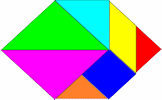
An online challenge to use all the pieces of the tangram puzzle to fit into the outlines provided.
The short web address is:
Transum.org/go/?Num=416
A series of tangram challenges in increasing order of difficulty. This page is designed to be projected onto a screen for a whole class to see.
The short web address is:
Transum.org/go/?Num=665
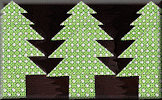
Accurately construct a tangram puzzle then use it to make a Christmas tree and answer a short quiz.
The short web address is:
Transum.org/go/?Num=664
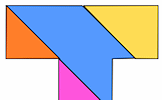
Use the pieces of the T puzzle to fit into the outlines provided. A drag, rotate and drop interactive challenge.
The short web address is:
Transum.org/go/?Num=429
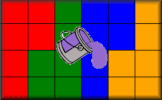
Use the colours to dissect the outlines into congruent parts.
The short web address is:
Transum.org/go/?Num=985
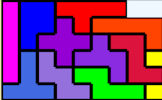
Arrange the twelve pentominoes in the outline of a rectangle.
The short web address is:
Transum.org/go/?Num=523
There are solutions with diagrams to this puzzle but they are only available to those who have a Transum Subscription.
Do you have any comments? It is always useful to receive feedback and helps make this free resource even more useful for those learning Mathematics anywhere in the world. Click here to enter your comments.


Henry Ernest Dudeney, Amusements In Mathematics
Friday, March 16, 2018
"The late Mr. Sam Loyd, of New York, who published a small book of very ingenious designs, possessed the manuscripts of the late Mr. Challenor, who made a long and close study of Tangrams. This gentleman, it is said, records that there were originally seven books of Tangrams, compiled in China two thousand years before the Christian era. These books are so rare that, after forty years' residence in the country, he only succeeded in seeing perfect copies of the first and seventh volumes with fragments of the second. Portions of one of the books, printed in gold leaf upon parchment, were found in Peking by an English soldier and sold for three hundred pounds.
A few years ago a little book came into my possession, from the library of the late Lewis Carroll, entitled The Fashionable Chinese Puzzle. It contains three hundred and twenty-three Tangram designs, mostly nondescript geometrical figures, to be constructed from the seven pieces.
[Read more about Henry Ernest Dudeney]"
More Tangram Maths, Transum
Friday, March 16, 2018
"Write down the mathematical shape names for each of the 7 pieces.
Place the pieces in order of size, with the smallest first.
If a tangram puzzle makes an 8cm by 8cm square, what would be the areas of each of the pieces?
What would be the perimeters of each of the pieces?
What are the angles in each of the pieces?"