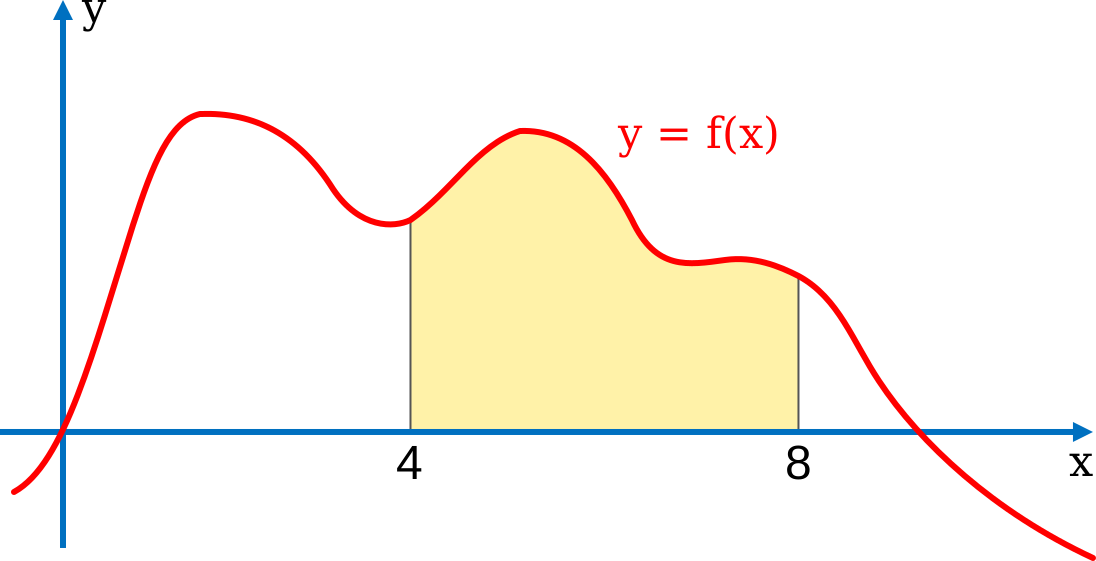
The gradient of \(f(x)\) when \(x=4\) is \(1\).
The area under the curve \(y=f(x)\) between \(x=4\) and \(x=8\) is \(12\) square units.
Which of the following expressions can be evaluated from this information?
| Gradient to be evaluated | Answer |
|---|---|
| The gradient of \(y=f(x)+3\) at \(x=4\) | |
| The gradient of \(y=-f(x)\) at \(x=4\) | |
| The gradient of \(y=5f(x)\) at \(x=4\) | |
| The gradient of \(y=f(x+2)\) at \(x=4\) | |
| The gradient of \(y=f(x-1)\) at \(x=3\) | |
| The gradient of \(y=f(x+3)\) at \(x=1\) | |
| The gradient of \(y=f(-x)\) at \(x=-4\) | |
| The gradient of \(y=f'(x)\) at \(x=4\) | |
| The gradient of \(y=f''(x)\) at \(x=4\) | |
| The gradient of \(y=f''(x-3)\) at \(x=4\) |
| Integral to be evaluated | Answer |
|---|---|
| \(\displaystyle \int_{4}^{8}\bigl(f(x)+7\bigr)\,dx\) | |
| \(\displaystyle \int_{4}^{8}\bigl(f(x)-5\bigr)\,dx\) | |
| \(\displaystyle \int_{2}^{6}f(x+2)\,dx\) | |
| \(\displaystyle \int_{4}^{8}f(x-2)\,dx\) | |
| \(\displaystyle \int_{4}^{8}-f(x)\,dx\) | |
| \(\displaystyle \int_{4}^{8}f(-x)\,dx\) | |
| \(\displaystyle \int_{4}^{8}5f(x)\,dx\) | |
| \(\displaystyle \int_{-8}^{-4}f(-x)\,dx\) | |
| \(\displaystyle \int_{1}^{2}f(4x)\,dx\) | |
| \(\displaystyle \int_{3}^{7}\bigl(f(x+1)+2\bigr)\,dx\) |
Sign in to your Transum subscription account to see the answers
This maths lesson starter is designed to be projected onto a whiteboard to initiate whole-class discussion.
More Advanced Maths Lesson Starters here.
Do you have any comments? It is always useful to receive feedback and helps make this free resource even more useful for those learning Mathematics anywhere in the world. Click here to enter your comments.
This activity was inspired by the resource called "What else do you know?" from Underground Mathematics.