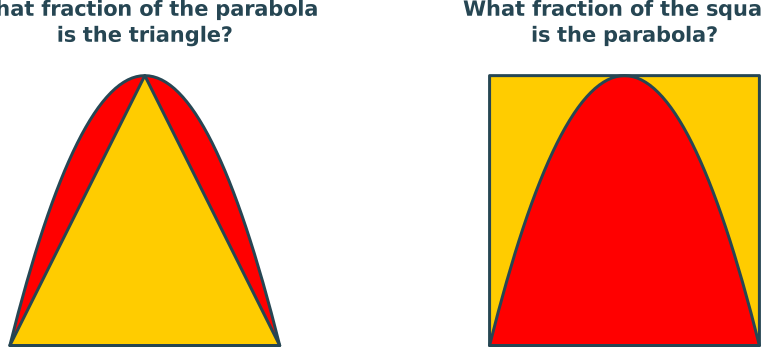
In the first diagram, a triangle is inscribed in a parabola. Its apex is at the maximum point of the parabola, and its base has exactly the same endpoints as the parabola’s base. In the second diagram, the same parabola is placed inside a square, touching the top side at its maximum point and sharing its base with the bottom side of the square.
Topics: Starter
How did you use this starter? Can you suggest
how teachers could present or develop this resource? Do you have any comments? It is always useful to receive
feedback and helps make this free resource even more useful for Maths teachers anywhere in the world.
Click here to enter your comments.
Previous Day | This starter is for | Next Day
More Mathematics Lesson Starters
Erick Lee, BlueSky
Saturday, June 20, 2026
A couple of questions for the final day of my #calculus class. The hexagon question was from a post at the other place by Henk Reuling. I added the square version as a simplified option. #ITeachMath #MathsToday
— Erick Lee (@theericklee.bsky.social) June 19, 2026 at 7:36 AM
[image or embed]
How did you use this resource? Can you suggest how teachers could present, adapt or develop it? Do you have any comments? It is always useful to receive feedback and helps make this free resource even more useful for Maths teachers anywhere in the world. Click here to enter your comments.
Your access to the majority of the Transum resources continues to be free but you can help support the continued growth of the website by doing your Amazon shopping using the links on this page. Below is an Amazon link. As an Amazon Associate I earn a small amount from qualifying purchases which helps pay for the upkeep of this website.
Educational Technology on Amazon
GCSE Revision and PracticeWhatever exam board you use for GCSE Mathematics, this book by David Rayner remains an all-round winner. With this latest edition presented in full colour and completely updated for the new GCSE(9-1) specifications, this uniquely effective text continues to increase your chance of obtaining a good grade. This book is targeted at the Higher tier GCSE, and provides a wealth of practice with careful progression, alongside substantial revision support for the new-style grading and exam questions. With all the new topics included, and a dedicated section on using and applying mathematics, this unique resource can be used either as a course book over two or three years or as a revision text in the run-up to exams. more... #ad |
|
||||