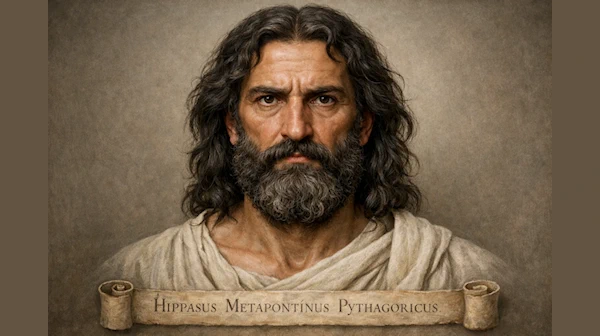
Hippasus of Metapontum was a Greek philosopher and mathematician active in the early 5th century BCE, born around 530 BCE in the city of Metapontum (or possibly nearby Croton or Sybaris) in Magna Graecia, southern Italy. He was an early follower of Pythagoras and a prominent member of the Pythagorean brotherhood, a secretive school that combined mathematics, philosophy, and mysticism. The Pythagoreans believed that the universe was governed by harmonious numbers expressible as ratios of integers, and they viewed numbers as the fundamental essence of reality. Hippasus belonged to the more mathematically inclined faction known as the Mathematici, in contrast to the more religiously focused Acusmatici. Little is known of his personal life beyond these affiliations, as no writings by him survive, and ancient accounts are fragmentary and often contradictory.
Hippasus is most famously associated with the discovery—or at least the public revelation—of irrational numbers, particularly the fact that the square root of 2 (?2) cannot be expressed as a ratio of two integers. This revelation emerged from geometric considerations, such as the diagonal of a unit square, whose length proved incommensurable with the side. Such "surds" (a term later used for irrational roots) shattered the Pythagorean doctrine that all magnitudes were commensurable and could be represented by rational numbers. The discovery was profoundly disturbing to the brotherhood, as it undermined their core belief that "all is number" in a harmonious, rational sense. While ancient sources do not unanimously credit Hippasus directly with the proof, later traditions link him to this breakthrough, which marked a pivotal moment in the history of mathematics by introducing the concept of irrationality.
According to legend, Hippasus met a tragic end for divulging this secret. Stories claim that he either drowned at sea—perhaps thrown overboard by fellow Pythagoreans—or was expelled from the brotherhood and punished by the gods for impiety in revealing what was meant to remain esoteric knowledge. Some versions tie his fate to the construction of the dodecahedron (a Platonic solid linked to cosmic harmony) rather than irrationality directly. Modern scholars regard these dramatic tales of murder or divine retribution as likely mythical embellishments, with no reliable ancient evidence naming Hippasus explicitly as the punished individual. Nonetheless, he died around 450 BCE, and his legacy endures as the figure symbolizing the dramatic encounter between Pythagorean idealism and the unsettling reality of irrational numbers, forever tying his name to the origins of surds in Western mathematics.
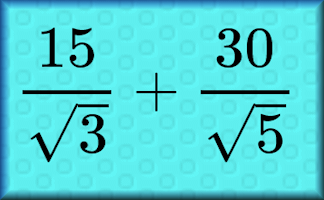
Appreciate the work of Hippasus of Metapontum by trying some of the maths that this mathematician is known for.
There is an activity called Surds that you could try right now. A self-marking exercise on calculating, simplifying and manipulating surds (also known as radicals).
So there's no better time than the present to learn some mathematics from the past: let's Go!