
Quadrant
I
Angle
45°
Radians
π/4
sin θ
0.707
cos θ
0.707
tan θ
1.000
The orange horizontal distance shows \( \cos \theta \), the green vertical distance shows \( \sin \theta \), and the purple tangent line shows \( \tan \theta \).
I
45°
π/4
0.707
0.707
1.000
Use the animation by dragging the red dot around the edge of the circle. As the dot moves, the angle \( \theta \) changes, and the display underneath shows the size of that angle in both degrees and radians. Watch the point’s coordinates as it moves: the \(x\)-coordinate gives \( \cos \theta \), and the \(y\)-coordinate gives \( \sin \theta \). This helps you see that the sine and cosine ratios are linked directly to positions on a circle of radius 1.
The animation also shows how the tangent ratio changes. When the dot is near the top or bottom of the circle, the tangent value becomes very large, because \( \cos \theta \) is close to zero and \( \tan \theta = \dfrac{\sin \theta}{\cos \theta} \). You can use the animation to spot patterns, such as which angles have positive or negative sine, cosine and tangent values, why some angles have the same sine or cosine value, and how special angles like \(30^\circ\), \(45^\circ\), \(60^\circ\), \(90^\circ\) and \(180^\circ\) appear in radians.
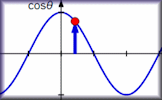
See angles, in either degrees or radians, on the unit circle and the graph of the trigonometric function.
The short web address is:
Transum.org/go/?Num=1061
Sine, cosine and tangent ratios are used to find sides and angles in right-angled triangles.
The short web address is:
Transum.org/go/?Num=71
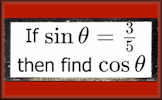
Finding the exact values of sine, cosine and tangent of angles if given a different trig ratio.
The short web address is:
Transum.org/go/?Num=896
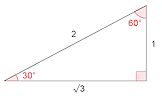
A self-marking exercise on finding the exact values of sine, cosine and tangent of special angles.
The short web address is:
Transum.org/go/?Num=543
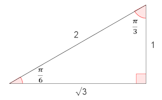
A self-marking exercise on finding the exact values of sine, cosine and tangent of special angles given in radians.
The short web address is:
Transum.org/go/?Num=1054
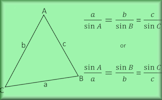
A self-marking exercise on the sine rule, cosine rule and the sine formula for finding the area of a triangle.
The short web address is:
Transum.org/go/?Num=662
Here are some basic, general questions, that you might like to investigate.
Do you have any comments? It is always useful to receive feedback and helps make this free resource even more useful for those learning Mathematics anywhere in the world. Click here to enter your comments.