Missing Square Puzzle

A Maths Starter of The Day

Missing Square Puzzle
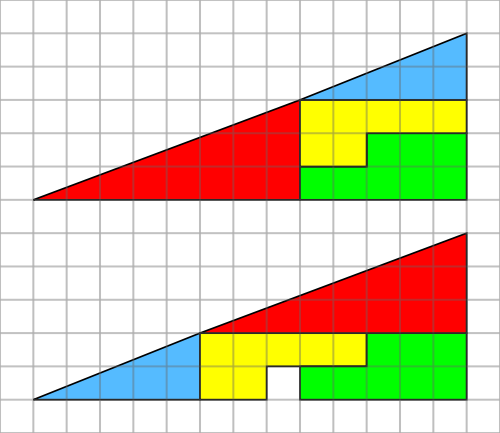
The four coloured pieces can be put together in two different ways to make these shapes with base 13 units and height 5 units. Why is there one square missing in the second arrangement? 


Starter of The Day Menu | Transum Software | Privacy Policy


Topics: Starter | Mensuration | Puzzles | Ratio | Shape

  • David, Kawartha Pine Ridge District School Board
  • Wednesday, March 21, 2012
  • "My main concern is that this references the shape as a right-triangle which neither is in actuality. I think this throws the students off a possible thinking path. If instead it referred to the shape less specifically, then students might more readily venture down this path."
  • Transum,
  • Thursday, March 22, 2012
  • "Good point David. The phrase 'right-angled triangles' has now been replaced with the word 'shapes' in the text above. Thanks very much for the suggestion."

How did you use this starter? Can you suggest how teachers could present or develop this resource? Do you have any comments? It is always useful to receive feedback and helps make this free resource even more useful for Maths teachers anywhere in the world.
Click here to enter your comments.

If you don't have the time to provide feedback we'd really appreciate it if you could give this page a score! We are constantly improving and adding to these starters so it would be really helpful to know which ones are most useful. Simply click on a button below:

Excellent, I would like to see more like this
Good, achieved the results I required
Satisfactory
Didn't really capture the interest of the students
Not for me! I wouldn't use this type of activity.

This starter has scored a mean of 4.2 out of 5 based on 101 votes.


Previous Day | This starter is for 26 July | Next Day

Transum Shop Visit the Transum Online Shop Transum Shop
Transum Shop

Answers

Neither of the 13×5 triangles has the same total area as its supposed component parts. The four figures (the yellow, red, blue and green shapes) total 32 units of area, but the triangles are 13 wide and 5 tall, so it seems, that the area should be 32.5 units. But the blue triangle has a ratio of 5:2, while the red triangle has the ratio 8:3, and these are not the same ratio. So the apparent combined hypotenuse in each figure is actually bent. A full explanation can be found on Mark Wieczorek's Weblog.

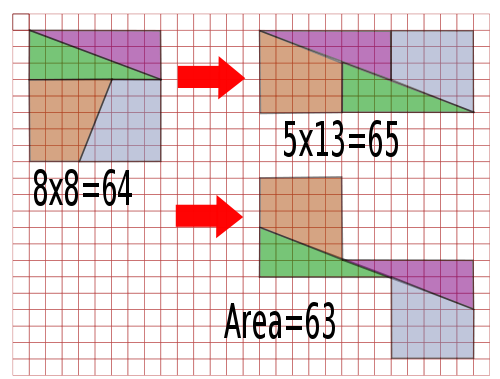
Chess Board Paradox

Sam Loyd presented this Chessboard Paradox at the American Chess congress in 1858. Notice the Fibonacci numbers which can be found in both of these diagrams.


Laptops In Lessons

Teacher, do your students have access to computers?
Do they have Laptops in Lessons or iPads?

Whether your students each have a TabletPC, a Surface or a Mac, this activity lends itself to eLearning (Engaged Learning).

Laptops In Lessons

Here is the URL for a concise version of this page without comments or answers.

Transum.org/go/?Start=July26

Students can create their own presentation of the Missing Square Puzzle to show to other classes or in an assembly. Here are some guidelines for using PowerPoint 2007:

On the Home tab, in the Drawing group, click Arrange, point to Align, and then click Grid Settings.
Tick the Snap objects to grid and the display grid on screen boxes. Select from the dropdown box a spacing of 1cm.

Snap to grid

The red and blue right-angled triangles can be made using the "Right Triangle" tool which can be found in the Home tab, in the Drawing group.

The green and yellow shapes can be created by putting together a number of 1cm by 1cm squares. Upon completion of the shape drag over the shape to select all of the squares then select "Group" from the Format tab, Arrange group.

Turn the Snap To Grid option off an add custom animations to each of the shapes to make the first arrangement of shapes transform into the second.


The images on this page are from the Wikimedia Commons. The descriptions of the licences can be found on the following pages: Missing Square Puzzle and Sam Lloyd Image.
Maths is Important!

"Mathematics equips pupils with uniquely powerful ways to describe, analyse and change the world. It can stimulate moments of pleasure and wonder for all pupils when they solve a problem for the first time, discover a more elegant solution, or notice hidden connections. ...

Mathematics is a creative discipline. The language of mathematics is international. The subject transcends cultural boundaries and its importance is universally recognised. Mathematics has developed over time as a means of solving problems and also for its own sake."

Qualifications and Curriculum Authority

Apple

©1997-2013 WWW.TRANSUM.ORG

www.Transum.org