
When they danced as couples there was one person left over.
When they danced in threes one person was left over.
When they danced in fours one person was left over.
When they danced in fives one person was left over.

Topics: Starter | Factors | LCM | Number
How did you use this starter? Can you suggest
how teachers could present or develop this resource? Do you have any comments? It is always useful to receive
feedback and helps make this free resource even more useful for Maths teachers anywhere in the world.
Click here to enter your comments.
Previous Day | This starter is for 28 January | Next Day
Sign in to your Transum subscription account to see the answers
What if the problem above was changed?
What if the group sizes were 3,5,7 and 8?
This Starter is a simple problem which can be solved by using the Chinese remainder theorem first published in the 3rd to 5th centuries by the Chinese mathematician Sun Tzu. In its basic form, the Chinese remainder theorem will determine a number n that, when divided by some given divisors, leaves given remainders.
What is the lowest number that
when divided by 3 leaves a remainder of 2,
when divided by 5 leaves a remainder of 3,
and when divided by 7 leaves a remainder of 2?
Your access to the majority of the Transum resources continues to be free but you can help support the continued growth of the website by doing your Amazon shopping using the links on this page. Below is an Amazon link. As an Amazon Associate I earn a small amount from qualifying purchases which helps pay for the upkeep of this website.
Educational Technology on Amazon
The following was one of Alex Bellos' Monday Puzzles published in The Guardian online newspaper. it features the Indian mathematician Brahmagupta during the 7th century AD posed the following problem:
When eggs in a basket are taken out 2, 3, 4, 5 and 6 at a time, there remain 1, 2, 3, 4 and 5 eggs respectively. When they are taken out 7 at a time, none are leftover.
Find the smallest number of eggs that could be in the basket.


|
Teacher, do your students have access to computers such as tablets, iPads or Laptops? This page was really designed for projection on a whiteboard but if you really want the students to have access to it here is a concise URL for a version of this page without the comments: Transum.org/go/?Start=January28 However it would be better to assign one of the student interactive activities below. |
|
Here is the URL which will take them to a student number patterns activity.
Transum.org/go/?to=satisfaction
|
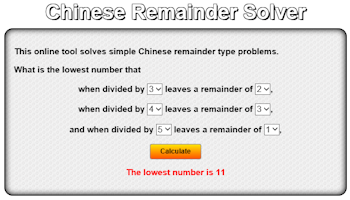
An interactive calculator designed to solve this type of problem is available to teachers, parents and turors when signed in. The solutions to this and other Transum puzzles, exercises and activities are available when you are signed in to your Transum subscription account. If you do not yet have an account and you are a teacher or parent you can apply for one here. A Transum subscription also gives you access to the 'Class Admin' student management system and opens up ad-free access to the Transum website for you and your pupils. |