
Sign In | Starter Of The Day | Tablesmaster | Fun Maths | Maths Map | Topics | More
|
New ActivityThe latest activity to be updated on this site is called "Frequency Trees" (Use a frequency tree to show two or more events and the number of times they occurred.). So far this activity has been accessed 21570 times and 1665 people have earned a Transum Trophy for completing it. 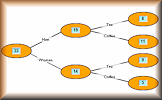
Frequency trees are a valuable tool in mathematics that allows pupils to represent data related to the occurrence of events and their frequencies. By using frequency trees, pupils can visually display the number of times two or more events have occurred, making it easier to understand and analyse the data. Featured ActivityWithout Lifting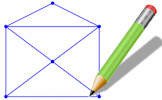 Can you draw these diagrams without lifting your pencil from the paper? This is an interactive version of the traditional puzzle. Some diagrams are possible while others are not. What is the rule? Recent News:Scientists finally complete Schrödinger’s 100-year-old color theoryResearchers have finally resolved a key problem in a 100-year-old theory of color, showing that the qualities we perceive in colors are intrinsic to the mathematics of color space itself. The discovery sharpens our understanding of human vision and could lead to more precise color technologies and visualizations. more... Scientists discover hidden math secret inside Chinese money plant leavesScientists have uncovered a hidden mathematical secret inside the leaves of the Chinese money plant: a naturally occurring geometric pattern known as a Voronoi diagram, something typically associated with city planning, computer science, and network design. By mapping tiny pores and looping veins in the plant’s leaves, researchers discovered that the plant organizes itself using the same kind of elegant spatial logic humans use to solve complex distance problems — without ever “measuring” anything. more... New AI method tackles one of science’s hardest math problemsPenn researchers have developed a smarter AI method for solving notoriously difficult inverse equations, which help scientists uncover hidden causes behind observable effects. By introducing “mollifier layers” that smooth noisy data, they’ve made these calculations more stable and far less computationally demanding. This could transform fields like genetics, where understanding how DNA behaves is key to disease research. more... Scientists just captured a mysterious quantum “dance” inside superconductorsIn a breakthrough experiment, scientists directly imaged how particles pair up in a system that mimics superconductors. Instead of behaving independently, the pairs moved in a synchronized, dance-like pattern—something never predicted before. This suggests a major gap in the classic theory of superconductivity. more... This donut-shaped discovery just shattered a 150-year math ruleA 150-year-old rule in geometry has been proven wrong. Mathematicians found two different doughnut-shaped surfaces that look identical when measured locally but are actually different overall. For decades, researchers suspected this might be possible but couldn’t prove it—until now. The breakthrough reshapes how mathematicians understand the relationship between local measurements and global form. more... This simple change stops robot swarms from getting stuckIn crowded environments, more robots don’t always mean faster results—in fact, too many can bring everything to a standstill. Harvard researchers discovered a surprising fix: adding a bit of randomness to how robots move can actually prevent gridlock and boost efficiency. By allowing robots to “wiggle” slightly instead of marching in straight lines, they can slip past each other and keep tasks flowing smoothly. more... New light trap design supercharges atom-thin semiconductorsScientists have found a clever way to supercharge ultra-thin semiconductors by reshaping the space beneath them rather than altering the material itself. By placing a single-atom-thick layer of tungsten disulfide over tiny air cavities carved into a crystal, they created miniature “light traps” that dramatically boost brightness and optical effects—up to 20 times stronger emission and 25 times stronger nonlinear signals. These hollow structures, called Mie voids, concentrate light exactly where the material sits, overcoming a major limitation of atomically thin devices. more... |
Latest Newsletters:Have you read the latest Transum Newsletter or listened to the podcast? June 2026
🧩 Solvitude Festival
May 2026
🛡️ Knights of the Circular Table April 2026
✏️ Quazmere Quadrant puzzle April's Newsletter :: Podcasts March 2026
🦀 A Penguin and a Crab March's Newsletter :: Podcasts February 2026
🟰 Badges for the Cods February's Newsletter :: Podcasts January 2026
⌛ New Year and Time January's Newsletter :: Podcasts December 2025
🎄 ChristMaths Resources December's Newsletter :: Podcasts November 2025
💥 Rock, Paper, Scissors November's Newsletter :: Podcasts October 2025
⚽ Saint Bees Puzzle October's Newsletter :: Podcasts September 2025
⛳ Cost of Cows Puzzle September's Newsletter :: Podcasts August 2025
🍦 Puzzle of the Month August's Newsletter :: Podcasts July 2025
🎂 Amazing Puzzle |
Do you have any comments? It is always useful to receive feedback and helps make this free resource even more useful for those learning Mathematics anywhere in the world. Click here to enter your comments.
|
Never miss a Transum Tweet again by following Transum on Twitter. |
Transum also has a Facebook page just in case you wanted something else to follow: |
Sign Up for a Transum subscription