Paradox

A Maths Starter of The Day

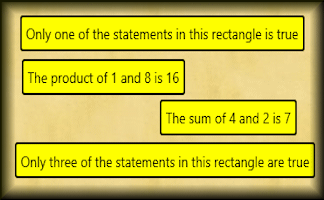
1. Two of the statements in this box are wrong.

2. There are 604800 seconds in a week.

3. The sum of the first 10 square numbers is 385.

4. A square is also a rectangle.

5. Multiplying a value by a whole number makes it bigger.

6. The numbers from 1 to 20 add up to 210.


Starter of The Day Menu | Transum Software | Privacy Policy


Keywords: Starter | Multiple Intelligences

  • Wikipedia,
  • Wednesday, April 25, 2007
  • "A paradox is an apparently true statement or group of statements that leads to a contradiction or a situation which defies intuition."
  • Natalie, London
  • Thursday, May 24, 2007
  • "I am thankful for providing such wonderful starters. They are of immence help and the students enjoy them very much. These starters have saved my time and have made my lessons enjoyable."
  • Rhonda, Arizona
  • Tuesday, April 28, 2009
  • "The answer states that multiplying by a negative whole number makes the answer negative. However, whole numbers cannot be negative by the definition of what whole numbers are. So that answer is true."
  • Wiliam, Lincoln
  • Friday, May 01, 2009
  • "Number 5 is wrong since multiplying a value by 1 which is a whole number gives an answer the same value as before neither smaller or bigger."
  • Meilyr Wyn, Ysgol Syr Thomas Jones
  • Wednesday, May 06, 2009
  • "Excellent Starter - Thank you very much
    There has been some debate amongst the department about whether a square is a rectangle. A square is not a rectangle if the definition of a rectangle includes "top and bottom same length as each other, right and left same length as each other but different length to top"."
  •  

  • The Best Maths Class Ever (7cd/m2), King Alfred's Oxfordshire
  • Wednesday, May 06, 2009
  • "It was a silly starter but it made us all think! Students: We thought that it was not very logical because the statement was true and false at the same time. We found that when it was false it became true."
  • Tony Graham, Stevenage, Hertfordshire
  • Thursday, May 07, 2009
  • "Sorry, Rhonda, it is possible to have a negative integer."
  • Nick Ball, Enoree, South Carolina
  • Thursday, May 06, 2010
  • "The definition we use in the USA for whole numbers are numbers 0 and greater. So you can't have a negative whole number. But the value you start with could be negative or a fraction...and one of our social studies teachers says that zero is a concept, not a number. So this was a dumb question."
  • Simon, Hampshire
  • Thursday, May 06, 2010
  • "Whole number means an integer (from the Latin 'integer'), so whole numbers can be negative. Natural numbers can only be positive - as to whether zero is a natural numbers depends on your view as a mathematician.
    A rectangle is defined as a quadrilateral with two pairs of parallel sides at right angles, so a square is a rectangle. Equally, a rectangle and a square are both parallelograms."
  • Chas, New York
  • Monday, June 21, 2010
  • "The person who said that there is no such thing as a negative integer is dead wrong!
    The answer key's reasoning for statement 5 is wrong, because there is no such thing as a negative whole number.
    Statement 5 IS false though, because 0 is a whole number."
  • Grace Harrison, West Kirby Grammar
  • Tuesday, May 03, 2011
  • "I loved this starter it really made me think and involved some good classroom discussions.
    Thanks."
  • Kiwi, New Zealand
  • Wednesday, May 04, 2011
  • "Here whole numbers cannot be negative, so multiplying by a negative integer would not be allowed. You are allowed to multiply by one, though, giving an equal but not larger answer so the statement is incorrect."
  • RB, UK
  • Friday, May 06, 2011
  • "Multiplying by 1 would also be a counter example for question 5 - so even if you don't want to include 0 and negatives as 'whole numbers' the statement is still false. I hope no one will debate whether or not 1 is a 'whole number'!"
  • Paula, Gillingham School
  • Friday, May 06, 2011
  • "Unfortunately, the answer sections gives a different statement for number 5 in that the word 'negative' is missing in the question. Will try it on the kids anyway and see if they spot the mistake. Thanks."

How did you use this starter? Can you suggest how teachers could present or develop this resource? Do you have any comments? It is always useful to receive feedback and helps make this free resource even more useful for Maths teachers anywhere in the world.
Click here to enter your comments.

If you don't have the time to provide feedback we'd really appreciate it if you could give this page a score! We are constantly improving and adding to these starters so it would be really helpful to know which ones are most useful. Simply click on a button below:

Excellent, I would like to see more like this
Good, achieved the results I required
Satisfactory
Didn't really capture the interest of the students
Not for me! I wouldn't use this type of activity.

This starter has scored a mean of 3.5 out of 5 based on 59 votes.


Previous Day | This starter is for 6 May | Next Day


Transum Shop Visit the Transum Online Shop Transum Shop
Transum Shop

Answer

Mathematically speaking the only incorrect statement is number 5. Multiplying by a negative whole number makes a positive value smaller.
But if there's only one statement wrong then statement 1 must be wrong too; but then two statements are wrong so statement 1 is correct.
Let's solve this paradox by agreeing that statement 1 is wrong because it refers to a box rather than a rectangle. What do you think?


Computer Teacher, do your students have access to computers?
Do you have "Laptops in Lessons"?

Whether your students each have a TabletPC or share a desktop PC, this activity lends itself to eLearning (Engaged Learning).

Laptop

Here is the URL which will take them to a concise version of this page.

Transum.org/go/?Start=May6

Here is the URL which will take
them to a student version of this activity.

www.transum.org/go/?to=Paradox