Paradox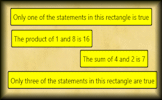
Arrange the mathematical statements so as not to create a paradox.
Maths Analogies
Make more of analogies to help remember mathematical concepts.
Tables Conga
Use the arrow keys to collect all the multiples in order while avoiding the Conga Virus!
Cubical Net Challenge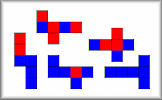
Find all the ways of painting the faces of cubes using only two colours.
Mystery Numbers
If '7 D in a W' stands for 7 days in a week, what do you think these mystery numbers are?
Tools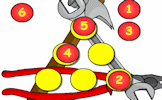
In how many different ways can the numbers be arranged to give the same totals?
Tran Towers
An adventure game requiring students to solve puzzles as they move through the old mansion.
Code Cracker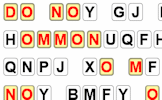
Crack the code by replacing the encrypted letters in the given text. There are lots of hints provided about code breaking techniques.
Geometry Toolbox
Create your own dynamic geometrical diagrams using this truly amazing tool from GeoGebra.
Hula Hoops
If a number of Hula Hoops are dropped on the floor, what is the maximum number of regions they might form?
Braille
Investigate the possibility of redesigning the Braille alphabet to make it easier to learn.
Multiple Intelligence Theory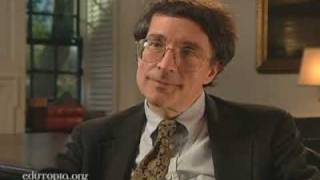
Dr. Howard Gardner explains his multiple intelligence theory.
Human Graph Shapes Video
Chapel Hill-Chauncy Hall teacher Kelly Overbye demonstrates how she uses Multiple Intelligences, to teach her students about the slope of graphs. [Similar to Transum's Human Graphs]
Wordles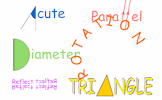
Remember these mathematical words for their shape and movement.
Pascal's Patterns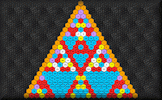
See the number patterns on Pascal's Triangle with this colourful, interactive application.
Geometry Toolbox
Create your own dynamic geometrical diagrams using this truly amazing tool from GeoGebra.

Analogies
Make more of analogies to help remember mathematical concepts.
Ancient Mysteries
This activity requires students to memorise fifteen numbers in a three by five grid.
Kim's Game 3
This is the Maths version of the traditional memory game. Memorise 10 mathematical facts then recall them as they disappear from view.
Mathterpiece
Memorise a picture made up of geometrical shapes

Mix and Match
Work out which team played which from the information given.
Number Recall
Can you improve your ability to remember telephone numbers?

Paradox
Can you solve this paradox by agreeing whether the statements are right or wrong?

Pi Day
March 14th is Pi Day. The third month and the 14th day relates to 3.14 which is pi to three significant figures. How many figures of pi can you memorise?

Rows of Roses
Can you draw 4 straight lines, without taking your pencil off the paper, which pass through all 9 roses?
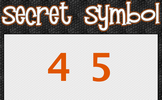
Secret Symbol
Place a symbol between the four and the five to get a number greater than four and less than five.
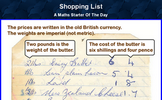
Shopping List
A quick quiz about five items on a shopping list written 40 years ago.

Shunting Problem
Allow two trains to pass by using the limited amount of siding space.

Squared Animals
Separate three rows of three animals using three squares.
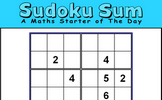
Sudoku Sum
What is the sum of the numbers missing from the given Sudoku puzzle?
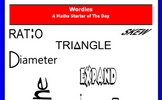
Wordles
Turn mathematical words into designs which will help you remember the meanings of the words.
28 items are currently in this category.
Teachers might find the complete Multiple Intelligences Topic List useful.
See also Thinking Skills.
The theory of multiple intelligences was proposed by Howard Gardner in 1983 as a model of intelligence that differentiates intelligence into various specific modalities rather than seeing it as dominated by a single general ability.
Gardner argues that there is a wide range of cognitive abilities, and that there are only very weak correlations among them. For example, the theory predicts that a child who learns to multiply easily is not necessarily generally more intelligent than a child who has more difficulty on this task. The child who takes more time to master simple multiplication:
1) may best learn to multiply through a different approach,
2) may excel in a field outside of mathematics, or
3) may even be looking at and understanding the multiplication process at a fundamentally deeper level, or perhaps as an entirely different process.
Here are some mathematical activities that call upon a pupil's multiple intelligences.